
Risk and Intensity vs. Representation: Reflections on Tehran Contemporary Sound
EFS PUBLICATIONSARTICLE
Rouzbeh Rashidi
12/3/202516 min read
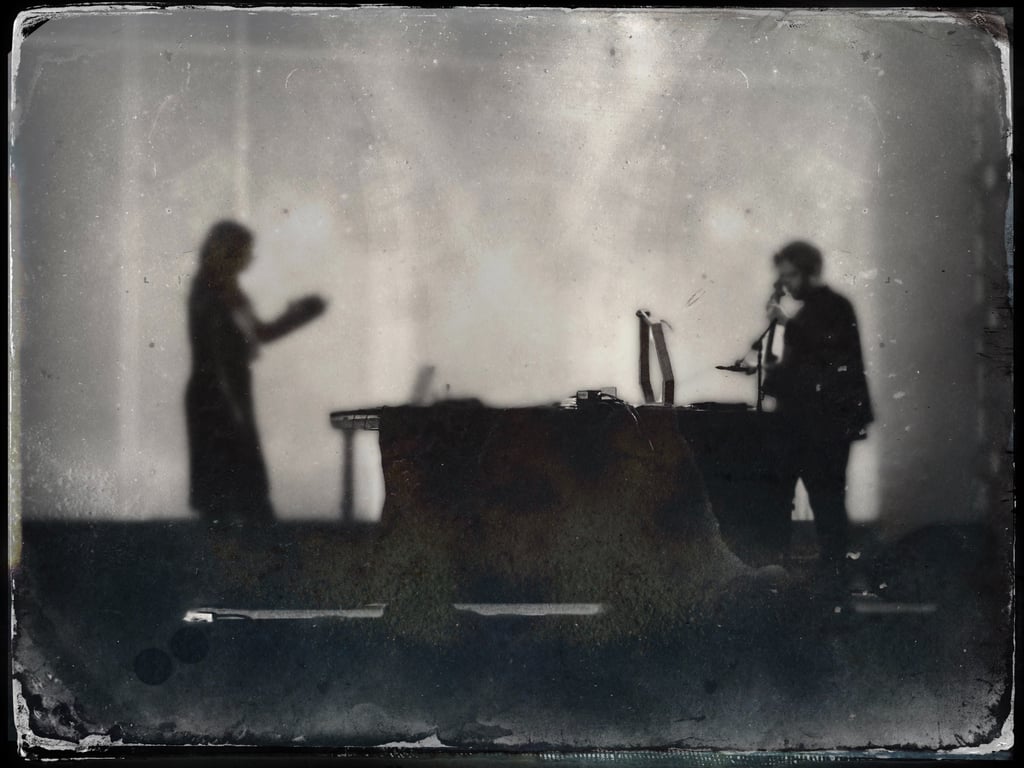
Tehran Contemporary Sound (TCS) is an annual Berlin-based festival and platform that showcases avant-garde and experimental music from Iran’s contemporary scene, engaging both artists in the Iranian diaspora and those in Iran. Over six editions to date, TCS has expanded from purely musical performances into a multifaceted event, including experimental cinema, sound installations, exhibitions, and masterclasses. Founded and curated by Behrooz Moosavi in 2018, TCS was conceived as a cross-border hub that brings together the diverse voices of Iran’s underground and alternative arts, fostering interdisciplinary dialogue and collaboration. This platform operates at the intersection of art and politics: many works reflect on Iranian socio-political realities, yet the festival’s ethos is not didactic politicalism. Instead, Moosavi’s curatorial approach emphasises creative risk-taking and an openness to chaos and experiment. After three years of close involvement with TCS (including developing its cinema section, though this analysis will focus on the musical dimension to avoid conflicts of interest), I have observed a dynamic tension at the heart of the festival’s programming. On the one hand, artists often invoke identity, nationality, and socio-political struggle in their work, addressing themes of injustice, human rights, and political precarity in Iran and the Middle East.
On the other hand, the most arresting performances have been those that plunge the audience into intense sensory experiences, invoking what Gilles Deleuze might call a “field of intensities” beyond representational narratives. This article aims to examine the tension between representation and pure intensity in TCS’s musical practices, drawing on thinkers such as Deleuze and Guattari, Henri Bergson, and Julia Kristeva. By analysing TCS through the lens of affect theory and continental aesthetics, we can situate the festival within broader discourses on art, affect, sonic thought, and the politics of representation. Ultimately, this inquiry asks: How might an experimental art platform like TCS move beyond the discursive re-telling of familiar socio-political narratives and instead invite its audience directly into what one might describe as “an abyssal, ungraspable, and intensely sensorial field of experience” – a space where art becomes an encounter rather than a statement?
Curatorial Philosophy: Risk and Productive Chaos
Behrooz Moosavi’s curatorial disposition with TCS can be characterised as fundamentally risk-oriented. In practice, the festival often embraces unpredictability, extremity, and productive chaos. Rather than curating a smooth, controlled programme, Moosavi deliberately cultivates an atmosphere in which disorder and experimentation can yield unforeseen artistic outcomes. The results of this approach are often works of striking sensorial and affective potency – performances that haunt the audience with their intensity and experimentality. Moosavi’s own artistic projects reflect this ethos: in one audio-visual collaboration, he and his partner describe their landscape as reacting “to the sensory, imagery, and auditory perception of a world in collapse,” translating experiences into “a chaotic and distorted common expression” with works that are never fixed but “subject to constant change – socio-politically and culturally”. This vision of art as something emergent from chaos (and perpetually in flux with the world’s turmoil) echoes the Deleuzian idea that actual creation happens on a plane of unpredictability and intensity rather than preordained order. Indeed, Moosavi’s stance resonates with Deleuze and Félix Guattari’s conception of the Body without Organs, the unstructured plane of intensity on which creative forces circulate freely. TCS provides just such a plane: a “smooth space” of thought and sound where artists can “rise up at any point and move to any other,” breaking from rigid paths.
Crucially, Moosavi does not impose a single aesthetic mandate on participants. His curatorial philosophy is capacious enough to accommodate wildly radical experiments alongside more cautious or conventionally representational works. In his words, TCS is a platform “capacious enough to accommodate all modes: the extreme, the half-measure, and the conventional.” The festival’s programming has featured full-spectrum electronic noise assaults, ambient electro-acoustic improvisations, and multimedia performances that push formal limits – but it has also included artists who take a more tempered approach, blending experimental music with narrative elements or traditional motifs. By “holding space” for this diversity, TCS functions as what Deleuze and Guattari might call a plane of consistency – a continuum on which multiple forms and trajectories coexist without one being prescribed as the norm. In the festival’s own event descriptions, one finds a conscious articulation of this ethos. For example, the Frequencies of Displacement concert was billed pointedly “not as a line-up” but as “a field of tension and intensities. A collective pulse drawn from lives lived across thresholds — political, cultural, and sonic. It’s a place of non-belonging… not of identity but of universalities”. This rhetoric – invoking universal intensity rather than identity – shows the Deleuzian influence on Moosavi’s curating. It suggests that TCS aims to dissolve rigid categorisations (national, stylistic, etc.) in favour of shared affective intensities that anyone can experience. The reference to “non-belonging” and “universalities” hints at a move beyond the politics of recognition (where art is tied to representing a specific identity or struggle) toward a politics of sensation and affect that cuts across individual identities.
Such an approach bears a philosophical kinship to Antonin Artaud’s vision of a theatre that rejects mere representation in favour of immediate, unmediated impact. Derrida, commenting on Artaud, noted that “The theatre of cruelty is not a representation. It is life itself, in the extent to which life is unrepresentable… [it] must construct a stage whose clamour has not yet been pacified into words.” In many ways, Moosavi’s TCS attempts to construct just such a stage in the realm of experimental music: a space where sound and performance operate at the threshold of meaning – a clamour of raw experience, not yet tamed by explication. By embracing risk and even chaos, the festival endeavours to let something genuinely new and intense emerge, rather than delivering neatly packaged messages. This curatorial risk can be seen as an effort to restore what Susan Sontag famously called the “erotics of art” over hermeneutics, privileging the work’s sensory impact and mystery rather than its translation into intellectual content. Moosavi appears willing to “throw the dice” with each edition of TCS, trusting that from a specific controlled disorder, meaningful artistic intensities will arise.
Representation and Identity: Front-Loaded Discourse in Performances
Despite TCS’s stated ethos of moving “beyond identity” into universal intensities, a recurring phenomenon in many performances (and installations) is a heavy reliance on representation and discursive context, especially at the outset of the works. Artists – perhaps feeling the weight of Iran’s complex socio-political reality – often foreground narratives of identity, nationality, and political struggle within their pieces. It is not uncommon for a performance to begin with extended spoken explanations, documentary footage, or symbolic imagery that explicitly references issues such as state repression, human rights abuses, or diaspora identity. In effect, these works reproduce, in aesthetic form, narratives already familiar from news media and political discourse, merely transposing them into the artistic domain. One might witness, for example, a musician project scenes of street protests or deliver a sombre monologue about censorship and resistance, before any music or abstract sensory element unfolds. Substantial portions of some pieces – 20%, 30%, or even nearly half of their duration – are devoted to this emotional–discursive exposition of themes. Only after this expository phase do the artists transition into the more purely sensorial or formally inventive dimension of their practice (for instance, launching into an improvised noise segment, a visual abstraction, or an immersive soundscape).
This front-loaded discursivity stems from admirable intentions: many artists feel a responsibility to bear witness to the injustices and struggles affecting their communities. By articulating the contextual background of their work, they aim to ensure the audience grasps its political stakes. However, there is a risk that this approach can undermine the piece’s aesthetic and affective power. The socio-political charge of these works often already exists at a deep, even unconscious level – both in the artists (as creators shaped by those realities) and in the audience (especially a Berlin audience likely attuned to current events in Iran and the Middle East). When an artwork spells out its message too explicitly, it can inadvertently anaesthetise the very perceptual openness and emotional receptivity it would otherwise cultivate. The time and energy spent narrating or explicating the context can dull the audience’s sensitivity to the work’s own deeper, non-verbal forces.
Philosopher Susan Sontag diagnosed this phenomenon in her essay “Against Interpretation”, critiquing the tendency to subjugate art to its content or message. “Interpretation is the revenge of the intellect upon art,” Sontag wrote – “to interpret is to impoverish, to deplete the world”. In many politically charged performances at TCS, one sees a form of pre-emptive interpretation: the artist interprets their own work in real time, translating it back into the familiar code of socio-political statements. This well-meaning impulse “depletes” the artwork’s world by reducing it to what can be said in ordinary language. The result is a kind of didacticism that, instead of enhancing the audience’s engagement with the political issues, might actually short-circuit the artwork’s ability to communicate those issues on the level of affect and embodied experience. As Sontag argued, the modern critical obsession with content has made art “problematic” by assuming that “a work of art by definition says something”. The artists in question seem to feel that unless they explicitly say what their piece is about (oppression, exile, etc.), its significance might be lost. But this assumption can become a self-fulfilling trap: by overemphasising what is said, they risk undermining what is felt.
From a broader perspective, the prevalence of such representational tactics at TCS reflects a common dilemma in contemporary art – especially art arising from contexts of political trauma or diaspora. There is often external pressure (from audiences, funders, or the artists’ own conscience) for the work to “address public problems” in a straightforward way. Yet, as one critic notes, “rarely are the politics of an artwork, even when it addresses political matters directly, any more penetrating than the statement of a problem… what political art does proffer is the experience of recognition”. In other words, much overtly political art stops at reaffirming what the audience already knows or feels, giving a momentary validation (“yes, these injustices are real and terrible”). This can undoubtedly be moving – “finding in art an expression of their political concerns… can be terribly affecting, because it is validating”. However, mere validation, as necessary as it might seem, is far from the radical potential that art can achieve. “Affirmation is available everywhere,” the same critic writes – “why look for it in art, when what the most valuable works offer up exists nowhere else?” The insinuation here is clear: art’s unique power lies not in confirming what we already think we know, but in giving us an encounter with something new – a sensation, perspective, or insight that we cannot glean from journalism, activism, or everyday discourse.
When TCS performances devote lengthy stretches to explicating Iran’s socio-political woes, they may inadvertently trade some of art’s singular capacity for transformative experience for a more conventional communicative role. There is an almost Brechtian echo in some of these works – as if the artists want to ensure the audience gets the message above all. But Bertolt Brecht himself was wary of simply preaching to the choir; his epic theatre, while didactic, also relied on estrangement effects to jolt audiences into new perceptions. The TCS artists’ didactic sections, in contrast, often employ familiar emotional tropes (a lament for martyrs, a recitation of oppression) which risk engendering empathy without the jolt of new insight. The audience, moved by the story, might actually become less open to the abstract sonic exploration that follows – having already been guided toward a specific frame of understanding. In sum, the representational, identity-forward register in these performances can create a conceptual filter that the subsequent sensory material must then struggle to overcome. Instead of approaching the sound with ears and mind wide open, listeners are processing it through the narrative that preceded it. The result can be a dampening of intensity: the music’s unconscious impact is continually pulled back into the gravity of the already-known story.
From Statement to Encounter: Embracing the Abyss of Pure Sensation
The critique above raises a pressing question: What if the artwork bypassed this representational detour and immediately immersed the audience in an unmediated field of sensations and affects? Such an approach would entail trusting the implicit socio-political charge to emerge through form, texture, and intensity, rather than explicating it in advance. The hypothesis is that by doing so – by plunging the audience directly into the catastrophe, into the “vertiginous zones where art becomes an encounter rather than a statement” – the result could be far more challenging, affectively resonant, and conceptually rich. In these zones, the audience might experience, on a visceral level, something of the truth of the situation (the fear, the anger, the hope of a people, for example), without needing it pointed out to them. This is where philosophical frameworks of affect and sensation become invaluable for articulating what is at stake.
Gilles Deleuze, in his studies of art (from Francis Bacon’s painting to cinema), repeatedly emphasises the difference between art that illustrates a story and art that conveys forces. In Francis Bacon: The Logic of Sensation, Deleuze praises Bacon for refusing to simply narrate horror or represent violence, instead rendering the force of those sensations directly on the canvas. “Bacon has always tried to eliminate the ‘narrative’,” Deleuze observes, “interested in violence not as a story or representation, but as itself a Figure”. The figure, in Deleuze’s vocabulary, is the sensible form that emerges when figurative representation is broken – it is the visible or audible presence of force itself. Translating this to the context of sound and performance: an artist concerned with, say, state violence in Iran might take a Baconian-Deleuzian approach by crafting a sonic Figure of violence – perhaps through raw distortion, chaotic noise, and fragmented rhythm – rather than describing or depicting violent events. The audience, encountering this sonic onslaught, would feel the affective charge (the horror, chaos, or anguish) in their nerves and bones, without a mediator. Deleuze argues that art’s power lies in such encounters, which “make us nervous,” bypassing our ready concepts and forcing new sensations upon us. The goal is not to be didactic but to create the conditions for what Deleuze calls “thinking through affects” – a thought that happens in the body and the unconscious before it is conceptualised.
Henri Bergson provides another angle on why immediate experience can be more potent than analysis or representation. Bergson famously held that “processes of immediate experience and intuition are more significant than abstract rationalism for understanding reality”. What we grasp through intuition – the felt sense of duration, the inexpressible qualities of lived moments – often escapes the net of intellectual representation. Applying Bergson’s insight, one could say that a 10-minute passage of wordless, immersive sound might convey the “duration” of living under oppression (the tension, the slow dread or the sudden flares of hope) more authentically than a verbal explanation ever could. The audience’s intuition, their capacity to resonate with the piece, can pick up on nuances that discursive language would flatten. Bergson also critiqued the way analysis spatialises and externalises phenomena that are essentially temporal and internal. A human rights narrative told onstage might inadvertently freeze a living, ongoing struggle into a static story with a beginning and an end; conversely, an evolving soundscape could mirror the open-ended, durational nature of social struggle – its constant ebb and flow – in a way language cannot. In this sense, plunging the audience into pure sonic duration is not an avoidance of the socio-political theme but potentially a more faithful mode of presenting it (albeit non-discursively).
Julia Kristeva’s distinction between the semiotic and the symbolic further illuminates why art might do well to minimise explicit symbolisation when dealing with affect-charged material. The symbolic corresponds to structured, articulate language – the domain of grammar, syntax, and explicit meaning, which inevitably frames things in terms of identity, categories, and logical order. The semiotic, by contrast, is the “mobile patterning of instinctual drives” that manifests as rhythms, tones, and bodily energy, especially before language. Kristeva notes that “the semiotic comes before the symbolic, is repressed by the symbolic, but also ‘speaks’ through and disrupts the symbolic through music, art, and poetry”. In a politically charged artwork, the injustice or trauma at hand might be better served by allowing the semiotic energies to surge forth – in wails of a violin, in distorted electronic pulses, in arrhythmic beats – rather than by only allowing the symbolic (in the form of verbal commentary or explicit representational imagery) to dominate. The semiotic “speech” of music and sound can communicate aspects of collective experience that literal speech cannot. It can carry what Kristeva, following Freud and Bataille, calls the abject: those facets of human experience (suffering, death, bodily vulnerability) that disturb our orderly sense of self and social identity. “The power of abjection,” Kristeva observes, is that it “disturbs identity, system, order; it does not respect bodies, positions, rules”. A sonic work that strikes at the abject – for example, a composition that makes one viscerally feel the disintegration of a body or a community – can shake listeners to their core, unsettling their comfortable frameworks. Such an affective shock might do more to spur reflection on political precarity than a well-meaning lecture could. In the context of Iran’s struggles, one might think of the difference between hearing an activist slogan versus hearing an inarticulate scream. The slogan stays at the level of the symbolic (what we think about the issue), whereas the scream operates on the semiotic level (forcing us to feel the raw pain or urgency behind the problem).
Another concept that helps articulate this shift from statement to encounter is Jean-Luc Nancy’s idea of listening as being “on the edge of meaning”. Nancy argues that listening (in music or sound art) involves a straining toward meaning that never fully solidifies – “to be listening is always to be on the edge of meaning, as if the sound were precisely nothing else than this edge”. In an immediate sonic encounter, the audience is kept on this edge: they are engaged in sense-making, but not handed a definite meaning. This edgy state can be profoundly generative, as it activates the listener’s own imaginative and affective faculties. The work becomes an encounter in the true sense: an open event in which meaning is in flux and being co-created, not a closed message to be decoded. If TCS artists trusted in this mode more – inviting the audience into an unsettling sound-world without preliminary explanation – they might find that the political “meaning” emerges all the stronger for not being directly shown. The listeners, inclined toward an opening, might come away not only emotionally affected but also cognitively activated, precisely because they had to traverse that abyss of non-signification and find their bearings. This resonates with Deleuze’s notion that real thinking occurs when we are forced out of our habits by an encounter that resists easy recognition. A performance that is an encounter rather than a statement cannot be passively consumed; it requires the audience to work with their feelings and thoughts to integrate the experience.
In the safe space of an experimental music festival, there is nothing to lose and much to gain by pushing audiences into these deeper waters. By all accounts, Behrooz Moosavi understands this. His programming of extreme works indicates a curatorial hope that audiences will indeed rise to the challenge of the abyssal and ungraspable. TCS’s openness to the “extreme” and the “radical experiential” suggests that the festival is already halfway towards this vision of art-as-encounter. The lingering question is: why not lean into it completely? One answer might be out of respect for the diversity of artists – TCS, being non-prescriptive, will not force all contributors into a single avant-garde mould. Another consideration is the audience: a festival still needs to bring the public along, and some contextual framing can help less initiated listeners find entry points. Moosavi’s approach seems to be to keep the field open and see what happens, rather than enforce avant-garde purity. Yet, even within this pluralism, the philosophical analysis here suggests a transparent vector of intensity that the most powerful works tend to follow. It is along that vector – away from pre-digested representation and toward raw affective confrontation – that the festival’s unrealised potential likely lies.
Sonic Thought and the Future of TCS
In conclusion, Tehran Contemporary Sound stands as a fascinating case study in the interplay between art, affect, and representation in a context of political urgency. The festival embodies a terrain of potentiality, where disparate artistic modes coexist: some works lean toward the representational and narrative, while others drive hard into the unknown of sonic experimentation. Through a philosophical lens, we can understand this not just as an aesthetic choice but as a negotiation of how art thinks and communicates. Deleuze and Guattari famously asserted that “philosophy is concept creation, but it could as well be called a kind of music.” Conversely, music is a form of philosophical exploration in its own right. In the best moments of TCS, one witnesses what we might term sonic thought: performances that do not talk about ideas but rather think in and through sound itself. These are moments when, instead of illustrating a political condition, the artist produces a microcosm of that condition in affective form – a block of intensity, a texture of feeling that the audience can inhabit. It is here that TCS finds its conceptual core as an art platform: treating sound not as a vehicle for messages, but as a mode of understanding and encounter in its own right.
By drawing on thinkers like Bergson, Kristeva, Deleuze, and Artaud, we have sketched a framework in which the sensory and immediate elements of art are not opposed to the political or conceptual, but are in fact crucial to them. Affect and intensity are not apolitical; on the contrary, they are where the political may register in our flesh and unconscious, prompting a response that intellectual agreement alone cannot foment. A shriek or a drone can carry within it the truth of a historical moment – “the unspeakable made audible”, as one TCS programme described it. In contrast, a literal narration of that truth might only ever skim its surface. The challenge and opportunity for Tehran Contemporary Sound going forward is to continue cultivating an environment in which artists feel emboldened to communicate on this deeper level of intensity. This does not mean abandoning the ethical or referential concerns. Instead, it means allowing those concerns to be mediated by form, by experiment, by risk, trusting that the audience will get it in ways more profound than if they were told.
Critically, this analysis has avoided naming specific artists or works to focus on underlying ideas and to respect creators’ anonymity. The patterns discussed are therefore generalised. Indeed, not every performance at TCS falls into the trap of front-loaded discursivity, and some might argue that a bit of context-setting is sometimes necessary. Yet, the philosophical argument presented suggests that TCS’s highest calling – its most radical and rewarding path – is as a catalyst for encounters with art that leave us changed, not just informed. By inviting us directly into artistic “fields of intensity”, TCS can harness the unique power of experimental music and art to reshape perception and consciousness. In doing so, it aligns with what Julia Kristeva calls the poetic function of art: “to stretch our conceptual frameworks and liberate our thinking” beyond the transparent communicative language of everyday life. It also fulfils a Deleuzian injunction to art: to tap into the “unformed, unorganised” flows of life and let new forms of meaning crystallise from them.
Tehran Contemporary Sound, as both an idea and an event, underscores that art from contexts of struggle need not be confined to testimony or representation. It can instead operate on the plane of sensation, where it might ultimately have an even more visceral political impact. A festival like TCS shows that one can honour the reality of socio-political conditions not by reproducing the news, but by transforming those realities into affective experiences – by making the audience feel the urgency, the despair, the resilience in a direct encounter. In the delicate balance Moosavi maintains, there is diplomacy and inclusivity (no mode is excluded). Still, there is also the latent argument we have explored: that the truly “affectively charged and conceptually rich” works are those unafraid to dispense with the safety net of explanation. As TCS moves into future editions, its philosophical and artistic trajectory will be worth watching. It stands as a testament to the idea that in avant-garde music and sound art, risk is not just a curatorial gambit but a philosophical principle – the risk that through chaos, something new and true will emerge. And when it does, those moments of sonic truth will speak to us in ways that linger long after the festival’s sounds have faded, continuing to resonate as a form of understanding that is at once deeply emotional and profoundly thoughtful.
In the end, Tehran Contemporary Sound prompts us to reconsider what it means for art to be “political”. Perhaps the highest political art is not that which reiterates political content, but that which reconfigures our sensorium and makes us perceive differently. By that measure, the “productive chaos” cultivated by TCS is fertile ground for a politics of the unconscious – a politics enacted through affect, rhythm, and resonance. In that chaotic soundscape, new universals might be heard: not the abstract universals of doctrine, but the felt universals of human experience, pain, and hope, communicated beyond the limitations of identity. This, arguably, is where the festival’s philosophical significance truly lies: it is an experiment in freeing art to do what only art can do – to make us feel and thereby, perhaps, to make us think in new ways. And as long as TCS maintains this commitment to the encounter over the statement, it will remain not just a festival of contemporary sound, but a laboratory of modern thought in its most vibrant, sonic form.