
To Continue Is Not Nothing
EFS PUBLICATIONSARTICLE
Rouzbeh Rashidi
6/9/202617 min read
A Response to Bijan Moosavi’s How Decoloniality and Identity Politics Failed Me Completely
Bijan Moosavi’s recent essay, How Decoloniality and Identity Politics Failed Me Completely, published in Triple Ampersand, struck me with unusual force. It did so not because I recognised my own artistic method in Bijan’s, but because I recognised my condition within it. The essay names, with clarity, courage, and anger, a situation that many artists from Iran, the wider Middle East, and the Global South know too well: the discovery that institutions which speak fluently in the language of justice, decoloniality, inclusion, diversity, marginality, and historical repair can become strangely evasive precisely when confronted with work that is politically difficult, ethically inconvenient, formally unruly, or resistant to curatorial domestication.
Moosavi writes from the pressure point where exile, authoritarian memory, Western liberal rhetoric, and institutional hypocrisy collide. The essay is not simply a personal complaint, nor merely an account of professional disappointment. It is a diagnosis of a structure. It describes the afterlife of censorship inside spaces that imagine themselves to be anti-censorial; the return of silencing under the sign of care; the management of political pain through the bureaucratic rituals of progressive institutions. What is described here is not merely rejection. It is something more refined, more contemporary, and perhaps more difficult to name: a mode of silencing that operates through risk management, reputational anxiety, ideological embarrassment, bureaucratic delay, strategic illegibility, and the selective administration of empathy.
Yet if I begin from solidarity, I must immediately insist on difference. My path has not resembled Bijan’s. Over the last twenty-six years, I have not approached these matters by naming them directly. I did not make works explicitly “about” Iran, exile, political violence, the Islamic Republic, human rights, religion, gendered oppression, war, or the architecture of repression in any straightforward documentary, activist, or essayistic sense. I did not place these subjects on the surface of the work as declarative content. Instead, I moved—perhaps from necessity, perhaps from temperament, perhaps from some deeper psychic instinct—towards a cinema that is cryptic, occulted, oneiric, indirect, mysterious, and often wilfully estranged from topical legibility.
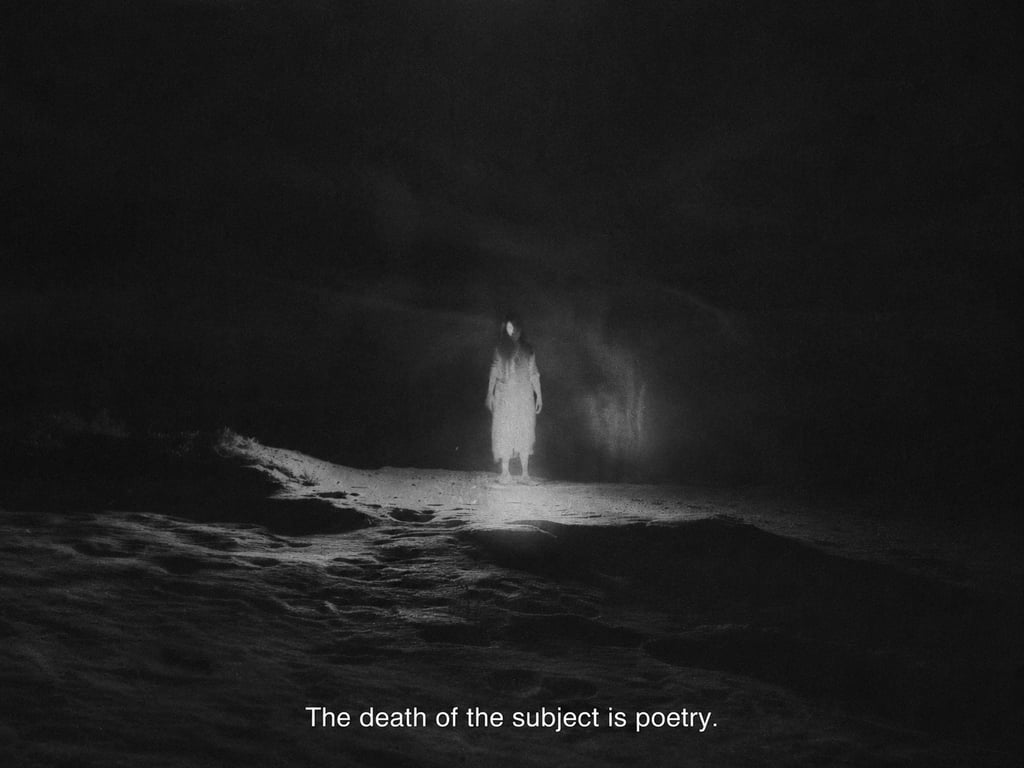
My films have been populated not by recognisable programmes of political representation, but by horror, science fiction, cosmology, spectral memory, metaphysical disturbance, unstable ontologies, scarred landscapes, deranged temporality, disembodied voices, alien perception, and images that seem to arrive from some other order of reality. I did not wish simply to speak about exile. I wanted to produce a cinema in which exile had already entered the organs of perception. I did not want to represent dislocation as a subject. I wanted dislocation to become the very grammar of the image.
This difference in method should not be mistaken for a difference in historical material. The material was always there. I was born in Tehran in 1980. I grew up in the shadow of war, in the long afterlife of revolution, inside a fractured social, political, and psychic world marked by violence, censorship, instability, religious authority, ideological surveillance, and the suffocation of speech. I later left Iran and entered Europe through exile, migration, and dislocation. These facts have never ceased to determine me. They are not biographical ornaments. They are the buried geology of the work.
But they entered my cinema in transmuted form. They did not appear as journalistic information, sociological evidence, or documentary declaration. They appeared as atmosphere, damage, rhythm, hallucination, distortion, silence, duration, dread, and metaphysical instability. As I have written elsewhere regarding Elpis, the impact of war on my formative years has always resided at the core of my filmography, yet I intentionally veiled it, allowing it to simmer beneath the surface. If politics is present in my work, it is present as an aftereffect, as pressure, as psychic weather, as the DNA of events rather than their surface appearance.
This is where my difference from Bijan becomes most significant. Bijan names the injury. I occult it. Bijan places the political object under direct pressure. I allow it to mutate into a cinematic universe in which the object itself has become unrecognisable, while its force remains everywhere. Bijan confronts Iran, Islam, hijab, human rights, censorship, diaspora politics, and Western institutional hypocrisy in their explicit historical forms. My cinema, by contrast, removes recognisable sociopolitical structures from the surface and allows them to return as spectres: in alien landscapes, post-apocalyptic atmospheres, ritualistic gestures, damaged bodies, metaphysical voids, haunted sounds, and images that seem to perceive the human from elsewhere.
This is not an evasion of politics. It is another ontology of politics.
For me, the political labour of cinema has never resided only in the declaration of content. It has resided in the remaking of perception itself. The rupture of identity, when passed through cinema, need not become a statement. It can become an altered sensorium. It can become a new mode of seeing. It can become a world.
The Homo Sapiens Project has always existed for me as a private laboratory of cinematic perception. It is not simply a series of films, nor merely an archive of experiments. It is a parallel life, an alchemical chamber, a long-term psychic and audiovisual procedure through which perception, memory, inner life, technological mediation, and the mysterious autonomy of the moving image are placed under pressure. Cinema, in this sense, is not illustration. Sound and image are not servants of a pre-existing message. They are volatile substances. They are reagents. They are elements in a laboratory whose outcome cannot be fully known in advance.
Over time, HSP became a field of occulted anthropology. It observes human beings as if they were already strange. It treats familiar landscapes as alien zones. It allows horror and science fiction to leak into ordinary perception. It refuses the comfort of stable narrative and instead constructs a cinematic organism made of fragments, mutations, repetitions, apparitions, and residues. The work does not ask the viewer to identify with a political subject in a conventional sense. It asks the viewer to undergo a disturbance in vision.
This disturbance has always mattered more to me than explanation. I have never trusted the demand that the injured subject must become transparent in order to be understood. There is a violence in this demand, even when it arrives with the vocabulary of sympathy. The colonised, racialised, diasporic, exilic, or minor subject is too often asked to clarify itself before a gaze that has already decided the conditions of its intelligibility. It is asked to become readable in the language of those who have historically misread it. It is asked to submit its historical damage to interpretation, to translation, to institutional digestion.
Against this demand, opacity becomes not confusion but dignity. To refuse transparency is not necessarily to refuse communication. It may be to protect the irreducibility of experience from the appetite of the dominant field. At the same time, cinema offers another possibility: not merely to hide, but to see otherwise. The fracture need not be converted into a sociological statement. It may become a new optical order. It may become an eye not yet fully conquered by inherited habits of vision.
Between these two gestures—the refusal to become transparent and the desire to remake vision—my cinema has tried to find its own path. It does not seek the transparent representation of identity. It seeks the transformation of identity into an altered mode of perception.
To be Iranian, to be from the Middle East, to be from the Global South, to be marked by exile, to be perceived through the geopolitical imagination of the West: these conditions do not necessarily oblige one to produce recognisable political content. They may instead compel the creation of a new metaphysical and cinematic order. The wound may not speak. It may dream. It may hallucinate. It may turn into a haunted planet. It may become a monstrous rhythm, a fragment of sound, a face half-absorbed by darkness, a landscape emptied of certainty, a body moving as if under the influence of invisible forces.
This is why I cannot accept the frequent assumption that only explicit thematic address counts as political seriousness. A cinema of horror, hauntology, cosmology, and metaphysical estrangement is not a retreat from history. It can be history digested at a deeper register. It can be the form taken by memories that resist discursive stabilisation. It can be the only adequate response to a life in which country, nation, language, home, culture, and metaphysical security have come apart.
In this sense, my films are not explanations of exile. They are the worlds exile forced me to build.
The question, then, is not whether Bijan’s approach or mine is more political. That would be a false and impoverished opposition. The question is rather: what happens to artists from our historical and geopolitical condition when they choose different aesthetic strategies? What happens when one artistic practice speaks directly and another speaks through opacity? What happens when one names the injury and another transmutes it into an autonomous cinematic universe? What happens when both, despite their radically divergent methods, arrive at the same structural wall?
This is where Bijan and I meet.
The difference in our aesthetic strategies has not protected either of us from the deeper structure that receives our work. Bijan’s work confronts difficult political content directly. Mine removes such content from immediate recognition and allows it to survive as spectral pressure, broken temporality, occulted atmosphere, and alien perception. But the institutional outcome can be strangely similar. If direct work is often treated as divisive, risky, inflammatory, reputationally inconvenient, or too politically charged, opaque work is treated as excessively obscure, insufficiently representative, too difficult to classify, insufficiently instrumental, or too resistant to the moral grammar through which institutions now validate themselves.
In one case, the artist is punished for saying too much too clearly. In the other, the artist is punished for refusing to convert experience into an immediately legible statement.
The problem, therefore, lies deeper than the distinction between direct and indirect art. It is not solved by choosing the “correct” aesthetic strategy. It is not solved by deciding whether to be explicit or cryptic, documentary or metaphysical, activist or poetic, transparent or opaque. The problem is not merely aesthetic. It is structural. It lies in the coloniality of the field itself: in those older formations of racial hierarchy, epistemic patronage, geopolitical suspicion, cultural extraction, and institutional narcissism that continue to determine how artists from the Global South are perceived before they have even been encountered.
Colonialism did not end when colonial administrations retreated. It survived in subtler and more intimate forms: in the organisation of knowledge, in the hierarchy of languages, in the distribution of legitimacy, in the architecture of taste, in the right to classify, in the authority to name. It survived as a regime of perception. It survived in the seemingly innocent question of what counts as serious art, what counts as intelligible politics, what counts as legitimate thought, and who is permitted to produce universality rather than merely supply cultural evidence.
Artists from the Global South enter the cultural field already burdened by an invisible demand: to become intelligible within categories they did not create. The Iranian artist is not received as “Iranian” in some pure, self-evident, neutral sense. Iranian identity is received through a dense network of projections: terrorism, Islam, oil, revolution, war, veil, repression, mysticism, danger, tragedy, exoticism, resistance, victimhood, fanaticism, poetry. Before the work is seen, a world of Western fantasy has already arrived to see it. Before the artist speaks, the artist has already been translated.
This translation is one of the deepest humiliations of the field. One is received not as thought, but as evidence; not as form, but as testimony; not as intelligence, but as cultural symptom; not as an artist constructing a world, but as a representative of a problem. Artists from Iran or the Middle East are often welcomed only when they fulfil a pre-existing function: dissident, victim, survivor, exotic, trauma-bearer, moral witness, or symbolic proof of institutional virtue. They are invited to confirm what the West already imagines about them. They are asked to appear inside a frame that has been prepared in advance.
This is where decolonial rhetoric becomes deeply treacherous. The institution may declare its commitment to diversity, but it retains the power to decide which kind of diversity is useful. It may celebrate marginal voices while quietly disciplining the forms through which those voices may appear. It may invite difference while requiring that difference to remain manageable, legible, morally flattering, and aesthetically assimilable. The institution may speak the language of transformation while leaving its own structures of value intact. Its declarations may not perform what they name; they may instead certify the institution as already ethical, already transformed, already absolved.
The statement “we are inclusive” can become a substitute for inclusion. The statement “we support marginalised artists” can serve as a shield against evidence of marginalisation. The statement “we are decolonial” can become a new style of colonial authority.
This is why the contemporary art institution is so powerful. It does not merely exclude. It incorporates. It does not merely silence. It programmes. It does not merely reject critique. It exhibits critique as proof of its openness. It can turn pain into theme, exile into curatorial language, trauma into funding narrative, political danger into carefully managed content, and dissent into cultural capital. It can host the marginalised artist as evidence of its virtue while leaving the deeper distribution of power untouched.
The marginal artist is welcomed on condition that the work remains useful: useful as sign, as symbol, as evidence, as moral decoration, as curated scar. But if the wrong pressure point is touched, if the expected posture is refused, if pain is not formatted properly, if the work is too angry, too obscure, too direct, too indirect, too politically inconvenient, too formally strange, too difficult to explain, too resistant to institutional consumption, the welcome narrows.
For artists from Iran and the wider Middle East, this condition is intensified by geopolitics. We are never received outside the storm of world events. Iranian artists do not enter the Western cultural field as neutral makers of images, sounds, performances, or texts. They arrive through the fog of sanctions, war rhetoric, Islamophobia, Orientalism, securitisation, refugee discourse, nuclear panic, human-rights spectacle, and imperial anxiety. The Middle East appears to the Western imagination again and again as problem, danger, trauma, threat, exception, or emergency. Even sympathy often arrives already contaminated by domination.
This is the enduring machinery of Orientalism, though its vocabulary has changed. The West did not merely misunderstand the East; it produced “the East” as an object of knowledge, fantasy, administration, desire, pity, and fear. That structure has not disappeared. It has merely updated its surface. The Orientalist museum, the colonial archive, the humanitarian NGO, the biennial, the progressive university, the diversity panel, the postcolonial conference, and the decolonial funding scheme may belong to different historical formations, but they can reproduce the same fundamental relation: the non-Western subject is rendered visible through a system that reserves for itself the sovereign right to interpret it.
This violence is not only institutional. It enters the body. It enters the psyche. The racialised or geopolitical subject does not merely encounter prejudice as an external obstacle; it is forced to inhabit a world in which the gaze of the other reorganises its own self-relation. It is seen before it sees. It is spoken before it speaks. It becomes overdetermined from without. Something similar occurs in the cultural field. Artists from the Global South often arrive already overdetermined by geopolitical fantasies. Their work is not encountered first as form, experiment, metaphysics, abstraction, humour, contradiction, or autonomous artistic thought. It is encountered as the expression of a category.
This is especially destructive for work such as mine, because my cinema has always refused the administrative clarity of category. I am Iranian, yes. I am Irish, yes. I am an experimental filmmaker, yes. I am an exile, yes. I am a maker of horror, science fiction, film essays, metaphysical atmospheres, poetic structures, and occulted cinematic worlds, yes. But none of these labels can contain the work. The work exists precisely in the zone where these categories break down, contaminate one another, and begin to mutate.
My cinema has attempted to transform the scar of identity into a radically altered mode of perception. It is not interested in asking the viewer to understand Iran as information. It is interested in producing a condition in which the world itself becomes unstable, haunted, alien, and damaged. It is not a cinema of explanation but of transmutation. It does not say: this is exile. It says: this is how the world looks when exile has entered the eye.
And yet this very strategy can become another reason for exclusion. If one speaks directly, one may be rejected for being too political. If one speaks indirectly, one may be rejected for being too obscure. If one offers testimony, one may be instrumentalized. If one refuses testimony, one may be ignored. If one becomes visible as identity, one may be consumed as representation. If one refuses representational visibility, one may become institutionally illegible. The trap is almost perfect.
This is why I increasingly distrust the promise that there exists a correct artistic method capable of defeating the structure. I do not believe that directness saves us. I do not believe that opacity saves us. I do not believe that political clarity saves us. I do not believe that metaphysical complexity saves us. I do not believe that beauty saves us. I do not believe that difficulty saves us. I do not believe that institutional fluency saves us. I do not believe that refusal saves us. Each strategy can be absorbed, neutralised, aestheticised, postponed, misread, or ignored.
The institution is not strong because it always says no. It is strong because it controls the conditions under which yes and no become meaningful. It decides which kinds of critique are admissible. It decides what kind of marginality is fundable. It decides what kind of suffering is legible. It decides which kind of opacity is prestigious and which is disposable. It decides when difficulty is genius and when difficulty is merely inconvenience. It decides which artists are “important” and which are merely persistent.
This is the deeper violence: not only exclusion, but the power to define the terms of appearance.
Politics, in this sense, is not merely the struggle over explicit messages, ideological positions, or named content. It is the struggle over what can be seen, heard, perceived, named, valued, and recognised as existing. The institution does not merely exclude certain artists. It organises perception in such a way that some forms of life and art appear as central, others as peripheral, others as unintelligible, and others as not appearing at all.
My entire artistic practice has been an attempt to redistribute perception at the level of cinema itself. But the institutional field performs its own counter-distribution. It decides what is visible as art and what remains a private obsession. It decides what counts as political and what is dismissed as hermetic. It decides when historical injury becomes programme and when it remains weather.
This is where the situation becomes almost metaphysical. Artists from the Global South, from the Middle East, from exile, from the ruins of imperial and post-imperial violence, are asked to perform an impossible labour. They must be legible enough to be included, but not so legible that they become threatening. They must be different enough to diversify the institution, but not so different that they disturb its epistemic comfort. They must bring pain, but not uncontrollable pain. They must bring politics, but not the wrong politics. They must bring identity, but in a form that can be consumed without altering the eater.
Bijan’s essay exposes this contradiction from one direction. My work has encountered it from another. Bijan’s directness and my opacity arrive at the same abyss.
At this point, I find myself moving toward a position that may sound like defeatism. Perhaps it is defeatism. But I do not experience it as nihilism. It is not despair in the theatrical sense. It is not a romantic collapse. It is not an adolescent refusal of the world. It is something colder, quieter, more severe, and perhaps more peaceful. There comes a point at which one ceases waiting to be redeemed by the machinery that has already made its terms clear. There comes a point at which one accepts, in advance, the likelihood of rejection, disappearance, misunderstanding, and structural defeat.
I do not mean this as resignation. I mean it as a refusal of false transcendence.
In this sense, my position has become almost Taoist. Before the result, defeat. Before recognition, disappearance. Before success, ruin. Before the institution pronounces judgment, the judgment has already been absorbed. This is not passivity. It is a form of non-forcing. It is the abandonment of coercive hope. It is the refusal to make one’s inner life dependent upon institutional reward. It is the discovery that one may continue precisely because one no longer believes in the redemptive promise of the field.
This matters because it offers a way of thinking of defeat outside the Western heroic model. In the dominant artistic mythology, the artist struggles, suffers, persists, and is eventually recognised. The narrative is fundamentally redemptive. But what if recognition never comes? What if the system does not secretly admire the excluded? What if the future does not repair the present? What if history does not vindicate us? What if the work continues without guarantee, without audience, without rescue, without institutional arrival?
Then one must learn another form of movement.
Failure, under such conditions, cannot be treated as an elegant alternative style. It cannot become merely another aesthetic costume, another anti-capitalist posture, another intellectual ornament. For some of us, failure is not a style at all. It is the climate in which the work has always had to breathe. It is the atmosphere surrounding the practice from the beginning. The question is therefore not how to aestheticise failure, but how to survive inside it without allowing it to destroy the work.
This brings me to the only honest conclusion I can presently reach: art becomes a private technology of endurance.
Not art as a career. Not art as an institutional ascent. Not art as a brand. Not art as professional visibility. Not art as progressive capital. Not art as inclusion into the circuits that have already decided the measure of value. Art, rather, as survival. Art as a hermetic chamber. Art as neurodivergent refuge. Art as autistic architecture of persistence. Art as an occult workshop. Art as a method of remaining alive. Art as the place where one continues to build forms after the world has declined to recognise their necessity.
I do not say this romantically. There is nothing glamorous about it. Survival is not beautiful in itself. It is often humiliating, repetitive, exhausting, absurd, and lonely. To keep making work under conditions of indifference is not heroic in the conventional sense. It is closer to a ritual performed in the absence of witnesses. One makes another film. Then another. One writes another text. Then another. One constructs another image, another sound, another ruined universe, another impossible form. The work continues not because the system has opened, but because stopping would mean allowing the system to define the limits of one’s existence.
This is perhaps the final resistance: not victory, not visibility, not welcome, not recognition, but continuation.
Under such conditions, to go on making work is already to have refused something. It denies the institution the right to determine whether the practice should exist. It refuses the geopolitical imagination that has already assigned the artist a role. It refuses the colonial demand for transparency. It refuses the progressive demand for manageable difference. It refuses the market’s demand for legibility. It refuses the archive’s indifference. It refuses the temptation to disappear completely.
And yet it also accepts disappearance. This is the paradox. The work continues while knowing it may vanish. The artist persists while accepting defeat. The films are made without any guarantee of reception. The original injury remains, but it is no longer offered as a petition. It becomes material. It becomes light. It becomes darkness. It becomes duration. It becomes a private cosmology.
This is where I think Bijan and I stand together, despite the radical difference between our artistic methods. Bijan has confronted the damage more directly. I have built a cinema in which it often survives only as echo, residue, distortion, vibration, nightmare, and spectral weather. Bijan has written through explicit political and institutional disillusionment. I have worked through occulted perception, horror, metaphysics, and cinematic estrangement. But we have arrived, I think, at a similar threshold of knowledge.
The institution is not neutral. The field is not innocent. The rhetoric of inclusion does not abolish coloniality. Visibility does not guarantee justice. Representation does not guarantee transformation. Direct speech does not guarantee recognition. Opacity does not guarantee protection. There may be no aesthetically correct way to pass through a structure whose power consists precisely in deciding, in advance, what forms of truth it can afford to recognise.
This does not mean that all gestures are equal. It does not mean that direct political confrontation and occulted metaphysical cinema are the same thing. They are not. Their forms, risks, languages, and historical responsibilities differ profoundly. But both can expose the same underlying structure. Both can reveal that the problem is not simply how the artist speaks, but how the world has already learned not to hear.
Perhaps this is why Bijan’s essay moved me so deeply. It did not mirror my method, but it illuminated my condition. It allowed me to see that the path of direct confrontation and the path of cryptic transmutation may arrive at the same institutional silence. It allowed me to understand that my refusal to make explicitly political work did not exempt me from the politics of reception. It allowed me to recognise that even the most private, hermetic, metaphysical cinema remains entangled in the colonial, racial, and geopolitical structures that organise the world in which it appears.
The wound cannot be escaped by naming it. The scar cannot be escaped by occulting it. The fracture cannot be escaped by transforming it into cinema. But perhaps it can be carried differently. Perhaps it can be made to vibrate at another frequency. Perhaps it can become not only testimony, but form. Not only accusation, but perception. Not only pain, but a method of seeing in the dark.
There may be no way to win. But the possibility of continuing remains.
And continuing, under these conditions, is not nothing.