The Problem of Spirituality in the Manifesto: An Interview with Rouzbeh Rashidi
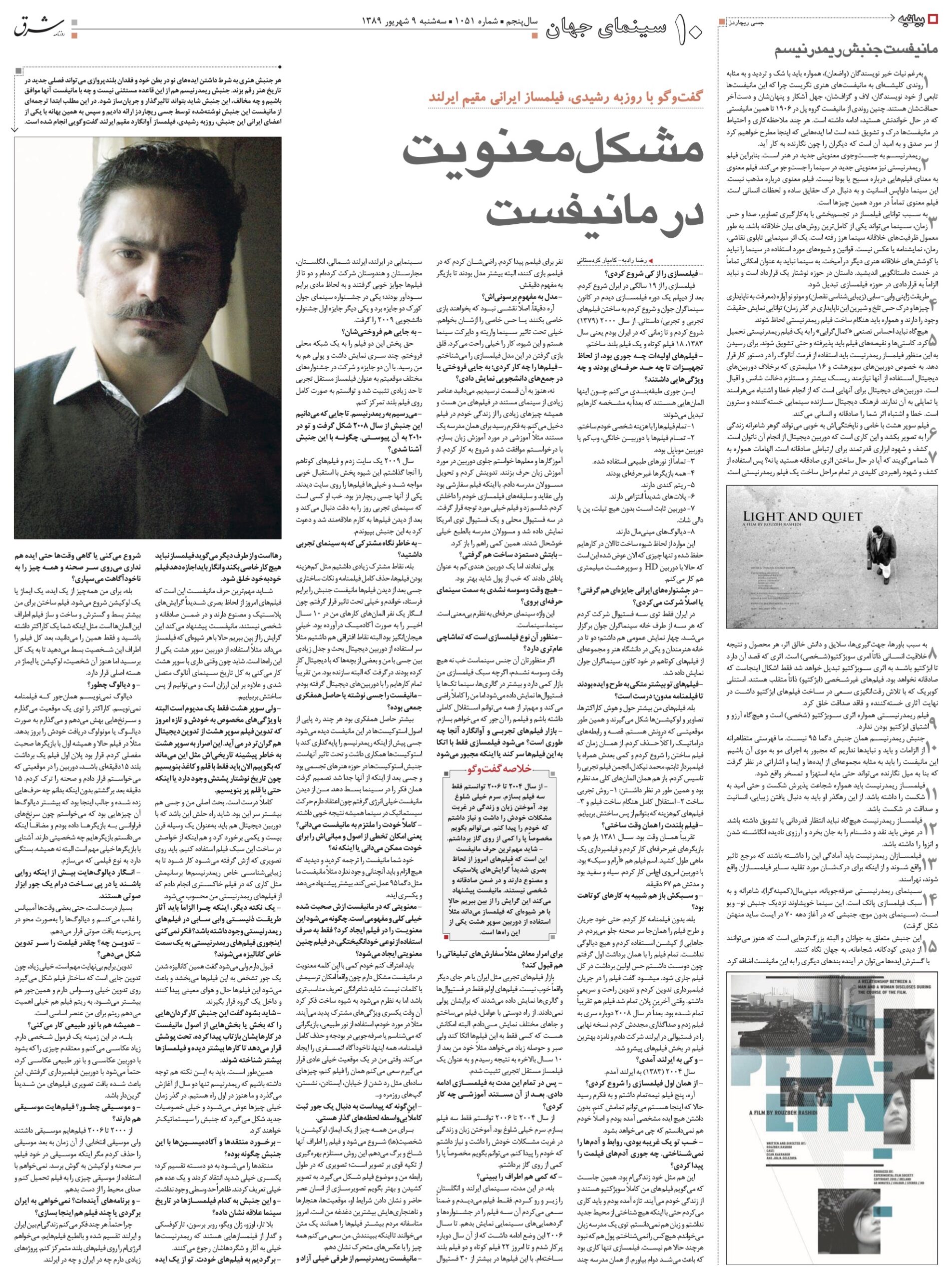
An interview with Rouzbeh Rashidi from the Iranian daily Shargh, presented above in facsimile, with a complete English translation below
By Reza Radbeh & Kamyar Kordestani · Shargh · 31 August 2010 · Translated from the Persian
A conversation with Rouzbeh Rashidi, Iranian filmmaker living in Ireland.
Any artistic movement, provided it carries new ideas at its core and is free of vain ambition, can open a new chapter in the history of art. The Remodernist movement is no exception to this rule, and whether we agree with its manifesto or not, it may yet prove influential and current-forming. In this feature we first presented a translation of the movement’s manifesto, written by Jesse Richards, and then, on that occasion, spoke with one of the movement’s Iranian members: Rouzbeh Rashidi, the avant-garde filmmaker living in Ireland.
When did you start making films?
I started filmmaking at nineteen, in Iran. After finishing school I took a filmmaking course at the Young Cinema Society and began making experimental and experimental-fiction films. I started in 2000 (1379), and by the time I left Iran, in 2004 (1383), I had made eighteen short films and one feature.
What were your early films like — how professional were they in terms of equipment, and what characteristics did they have?
Let me set it out like this, because these are the elements that later became the signature of my work: 1. I made all the films at my own personal expense. 2. All the films were shot on home cameras, webcams or mobile-phone cameras. 3. Natural light was used throughout. 4. All the actors were non-professionals. 5. They have a slow rhythm. 6. They have intensely abstract plots. 7. The camera is fixed, with no tilt, pan or dolly shot. 8. They have minimal dialogue. In terms of method, these points have stayed with my work to this day; the only thing that has changed is that I now also work with HD cameras and Super 8.
Did you win any prizes at Iranian festivals? Did you take part at all?
In Iran I only took part in three festivals, all three run by the Young Cinema Society. I also had four public screenings: two at the Artists’ House, one at the Art University, and a collection of my short films was shown at the Young Cinema Society itself.
Your films relied more on outlines and ideas than on a written screenplay; is that right?
Yes. My films take shape mostly around characters, images, locations and situations. I cut story and dramatic relationships out entirely from the moment I started making films, and a little later, together with my regular cinematographer Mohammad Nikdel, I founded the Experimental Film Society. The same general elements were still what I had in mind, along with: an experimental method of making; complete independence while making the film; and low-cost films that I could actually manage to produce.
Did you make your feature at that same time?
At almost the same time, in 1381. Again I worked with non-professional actors, and the shoot took about a month. The film was called Light and Quiet. I worked with an S-VHS camera. It was black and white and ran sixty-seven minutes.
And it too was made without a screenplay?
Yes, I worked without a screenplay. I even developed the film’s flow and outline right there on set. In places I used captions, and it had no dialogue. I kept the whole film to first takes, because I wanted the feeling of the first take to run through the film. I edited as I filmed, and the edit was quick and easy: when the last shot was done, the film was almost finished too. Later, in 2008, I returned to the film and redid its sound. I entered the final version in a festival in Ireland and it was nominated for best film in the vanguard section.
And when did you come to Ireland?
I came to Ireland in 2004 (1383).
Did you start making films right from the beginning?
Yes — I had five unfinished films, and it occurred to me that now that I was here I could finish them. I had come without any definite idea, and I honestly didn’t know myself what was going to happen.
Well, in a place where you knew no one, how did you find people for your film?
That, too, was like my life itself. This is exactly why I say my films are completely subjective and come out of my own life. I had just arrived and had to do something, even though I knew nothing of the new environment and didn’t know the language. I was studying at a language school. I knew no one. There was no money either — not that there is now! Still, I found a few people for my film and persuaded them to act in it, though they were models more than actors in the precise sense of the word.
Models in the Bressonian sense?
Yes, exactly. There was really no role in which they were expected to give a particular performance or deliver a particular emotion. I’m greatly influenced by cinéma vérité and direct cinema, and this method made the work very easy. I knew the knack of drawing performances in this model of filmmaking.
What did you do with the films — did you sell them anywhere, or show them at student gatherings?
No, we haven’t reached that part yet. You see, there are many elements of documentary cinema in my films, and I always fold a great deal of my own life into a film. It occurred to me to make an educational documentary about language teaching for that same school. My request was approved and I set to work: I asked the teachers and instructors to speak on camera about language teaching. I edited it and delivered it to the school authorities. Although the film was a commission, I worked my own filmmaking beliefs and tastes into it. My luck held and the film attracted real attention: it was shown at three local festivals and one festival in America, and the school authorities were naturally delighted. That opened my way a little.
Were you paid for making it?
They didn’t pay money, but they gave me a Handycam as a reward — which was perhaps better than money.
Were you never tempted to move towards professional cinema?
The term “professional cinema” seems meaningless to me. Cinema is cinema.
Meaning the kind of filmmaking that has a broader audience?
If you mean that kind of cinema, then no, I was never tempted. This kind of cinema has a small market and is mostly shown in galleries, cinematheques or festivals, but it satisfies me completely — and above all I can keep my independence and make my film the way I want to.
What is the market for experimental films like? Can a filmmaker get by on these films alone, or is he forced to take on advertising commissions, say, to make a living?
The market for experimental films, in Iran as anywhere else, is really not good. My first films were shown only at festivals and galleries, which paid nothing. I made films through friendship with cast and crew, and showed them in different places. It is possible to live from these films alone, but it takes great patience: I myself finally got there after ten years, when I became established as an independent, experimental filmmaker.
So you kept making films all through this period. After that educational documentary, what did you do?
From 2004 to 2006 I only managed to make three films. I was extremely busy. Learning the language and living far from home had their own difficulties, and I needed to find myself. You could say I deliberately eased my foot off the accelerator.
So as to look around a little too?
Yes — in that period I turned the cinema of Ireland and England inside out. I did nothing but watch films, and I showed my films at film gatherings as well. That state of affairs lasted until 2006. Then I became prolific, and to date I have made twenty-two short films and two features, which have been shown at more than thirty festivals and cinemas in Ireland, Northern Ireland, England, Hungary and India. The films won good prizes and were materially worthwhile for me: one won two awards at the Cork festival, and another took first prize at a 2009 student festival.
Have you sold any of them?
I sold the broadcast rights of those two films to a local network. They had several runs, and some money reached me. With those two prizes and the participation in various festivals, my position as an independent experimental filmmaker was consolidated to a great degree, and I was able to concentrate fully on feature films.
We come to Remodernism. As far as we know, the movement took shape in 2008 and you joined it in 2010. How did you become acquainted with it?
In 2009 I set up a website and put my short films on it. This method of distribution was very well received, and many people saw the films on the site. One of them was Jesse Richards. He is someone who follows current experimental cinema closely; after seeing the films he became interested in my work and invited me to join the movement.
Because of the shared view you had of experimental cinema?
Yes, we had many points in common, such as the low cost of the films, the complete elimination of the screenplay, and structural matters. After seeing the films, Jesse sent me the movement’s manifesto. I read it and was deeply affected, because it was as if someone had set out, in academic form, the elements of my work of the past ten years. It was very exciting. Of course we had our points of divergence too: over the use of digital cameras, for instance, a long argument broke out between Jesse and me and some of the others who had worked in digital — a constructive one, though. I had shot almost all my work on digital cameras.
Did Jesse write the manifesto, or was it the product of collective thinking?
It was mostly the product of collective thinking, though traces of the Stuckists’ principles can be seen in it. Before founding Remodernism, Jesse had collaborated with the Stuckists and is influenced by them. The Stuckist movement belonged to the visual arts; after separating from them, Jesse decided to extend the same idea into cinema. I drew a great deal of energy from the manifesto, because I believe systematic movement in cinema has always produced good results.
Do you consider yourself fully bound to the manifesto? That is, do you allow yourself the possibility of departing from its principles, or not?
You translated the manifesto yourself and saw that there is no such strict obligation in it — our manifesto doesn’t operate like Dogme 95, for example. It offers proposals, rather, and a set of ideas.
The spirituality spoken of in the manifesto is very general and conceptual. How can this spirituality be created in a film? Is it produced, say, through a kind of spontaneity?
I must confess I myself have a little trouble with this word “spirituality” in the manifesto, because it really cannot be drawn in words. Perhaps “the poetic” would be a better definition. But I think one can consider the method of making; then a set of shared features appears. In my own case, for instance: the use of natural light, actors I know, economy of budget and the complete elimination of the screenplay — all of these unconsciously create a particular atmosphere. When I find myself in a very ordinary situation, I try to film precisely that: simple things like crossing the street, standing, sitting, everyday chats and so on.
From the look of it, you are after a kind of completely unmediated recording of passing moments.
For me everything begins from an image, a location or a character, and I build the film around them. This approach depends on a strong reliance on the image — an image formed in the relation between me and the film’s subject. Depicting, or better, picturing the person present, and showing their condition, their situations, their norms and their aberrations, is my greatest preoccupation. Today, unfortunately, people read a film more than they watch it. I try to show everything with moving photographs.
The Remodernist manifesto is on the one hand very free and loose, and on the other it says the filmmaker should not do anything in particular — as if he must simply allow the film to create itself.
Perhaps the manifesto’s most important statement is that today’s films, visually, have intensely plastic and artificial tendencies, and are moreover neither honest nor personal. The manifesto proposes that we do away with this tendency by whatever means the filmmaker knows; the use of the Super 8 camera, for instance, is one of those ways. Perhaps because when you work with Super 8 you are connected to the whole history of analogue cinema — and besides, it is cheap, and we can afford to work with it.
But Super 8 is only a medium, albeit one with its own particular characteristics — and nowadays editing Super 8 film works out more expensive than editing digital. This insistence on Super 8 for the sake of its historical pedigree is like saying we should now write only with pen and paper because the history of writing stands behind them — or even write with a quill.
Quite right. This was the main debate between Jesse and me. Perhaps the solution is that the digital camera, too, should be treated as a tool of the twenty-first century, and that we should use its properties in making this style of film. The image it captures must be worked on until it reaches the Remodernists’ particular aesthetic — as I did in the film Grey (Khakestari), which counts among my Remodernist films.
One more point: why must the marks of the Zen-Buddhist way of wabi-sabi necessarily be present in Remodernist films? Don’t you think Remodernist films will be channelled in one particular direction this way?
I accept that, but one could say that this very channelling gives these films a kind of distinction; it lets them acquire a definite atmosphere and belong to a group.
Perhaps one could say the movement gives shelter to directors in whose work some part or parts of the manifesto’s principles are reflected, so that the works are seen more and the filmmakers become better known.
That is so. We should also bear in mind that Remodernism is only two years old and we are still at the beginning of the road. In the course of time many things will change, and many new characteristics will take shape that will make the movement more systematic.
How have critics and academics received the movement?
The critics can be divided into two camps: some criticised it very fiercely, and some praised it highly. There was, apparently, no middle ground.
And which filmmakers in the history of cinema has the movement shown interest in?
Béla Tarr, Ozu, Jean Vigo, Robert Bresson, Tarkovsky and Godard are among the filmmakers whose works and methods the Remodernists return to most.
Let us come back to your own films. Do you start from an idea — or do you sometimes have no idea at all, and simply go on set and entrust everything to your unconscious?
For me everything starts from an idea, an image or a location. Making a film, for me, is mostly the expansion, development and construction of the film around these elements. It is as if you had a character and knew only that; then you develop the whole film around that character until you arrive at a whole — but that character, location or image still stands at the core.
And what about dialogue?
I don’t write dialogue, just as I don’t write screenplays. I put the character into a situation, give them a few threads, and let it emerge as dialogue or monologue in its own time. In the film Now and Forever, for example, I first had a long talk with the actors. The opening shot of the film was to be a fifteen-minute long take. I set the camera on the position I wanted and left the scene. Fifteen minutes later I came back without knowing what words had been spoken — and the interesting thing was that most of the dialogue was exactly what I had wanted, because I had given the actors plenty of threads and, moreover, I knew what characters my actors had. Knowing your actors is very important — though not always. It depends on the kind of film I’m making.
It seems your dialogues, rather than being narrative or serving to build drama, are a kind of sonic instrument.
Very true — sometimes I even let the ambience dominate and place the dialogue, blurred, in the background of the sound texture.
What about editing? How much of the film do you shape in the edit?
Editing is infinitely important to me — enormously so, because the edit is where the structure of the film takes shape. I am obsessive about editing, and it keeps growing. I also give great weight to the film’s rhythm; rhythm, for me, is a fundamental element.
Do you always work with natural light as well?
Yes — I have a personal formula here. I photograph a great deal, and I believe that whatever can be photographed with a stills camera in natural light can certainly be filmed with a film camera. This is why the image texture of my films is intensely grainy.
And what about music? Do your films have music?
From 2000 to 2006 my films had music — found music, chosen from elsewhere. From then on I removed music, unless the music can be heard within the film itself, on the set and in the location. I don’t want to impose anything on the film by using music, or to lose the sound of the environment.
And your future plans? Don’t you want to come back to Iran, or make a few films here too?
Yes, certainly. Though I think my life is divided between Iran and Ireland — and my films likewise, as a result. I want to concentrate my energy on feature films. I have many projects, both in Iran and in Ireland.
A note on the films mentioned: the titles discussed in this interview — the feature Light and Quiet and the short films Grey and Now and Forever — were standalone works at the time of this conversation. They have since been absorbed into the Homo Sapiens Project: Grey and Now and Forever into Homo Sapiens Project (200), completed in 2020, and Light and Quiet into Homo Sapiens Project (201), completed in 2021. They remain part of Rashidi’s filmography, no longer as separate films but as part of that larger body of work.
Originally published in Persian in the Iranian daily Shargh, Tuesday 31 August 2010 (9 Shahrivar 1389), issue 1051, on the World Cinema page, alongside a Persian translation of Jesse Richards’s Remodernist Film Manifesto (2008), which is available in its original English elsewhere. This material has been restored, translated and recreated specifically for EFS Publications in 2026; the original page is preserved in facsimile above and in the EFS archive.