Subjects Are Always There: An Interview with Rouzbeh Rashidi
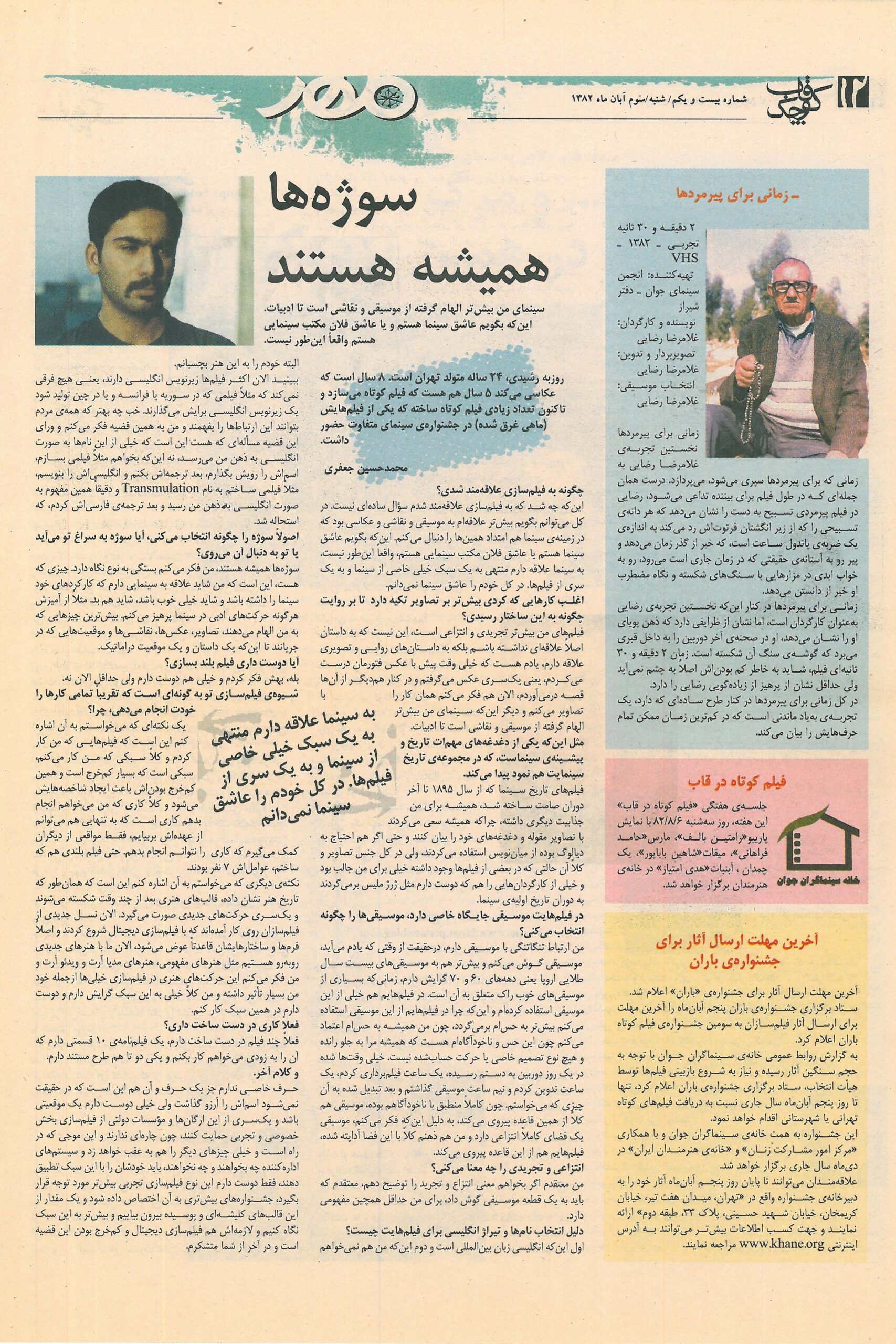
The earliest press interview with Rouzbeh Rashidi, from the Iranian weekly Mehr, presented above in facsimile, with a complete English translation below
By Emmsen Jafari · Mehr · 25 October 2003 · Translated from the Persian
“My cinema draws its inspiration more from music and painting than from literature. To say that I am in love with cinema, or in love with this or that school of filmmaking — it really isn’t so.”
Rouzbeh Rashidi, twenty-four years old, was born in Tehran. He has been photographing for eight years and making short films for five, and has made a large number of short films so far, one of which (The Drowned Fish) was shown at the Different Cinema festival.
How did you become interested in filmmaking?
How I came to be interested in filmmaking is not a simple question. On the whole I can say my interest lay more with music, painting and photography, and in cinema too I pursue the continuation of these same things. To say that I am in love with cinema, or in love with some particular school of filmmaking — it really isn’t so. I am interested in cinema, but in one very particular style of cinema and in a certain set of films. On the whole I don’t consider myself a lover of cinema.
Most of the work you have done leans more on images than on narrative. How did you arrive at this structure?
My films are mostly abstract and non-figurative. It isn’t that I have no interest in story at all; rather, I am interested in stories that are narrative and visual. I remember that a long time ago I used to work with photo-novels: I would take a series of photographs and draw a story out of them placed side by side. I think I still do the same thing now with images. And besides, my cinema takes its inspiration more from music and painting than from literature.
It seems that one of your important preoccupations is the history and heritage of cinema, which shows in your History of Cinema series as well.
The films of cinema’s history, made from 1895 to the end of the silent era, have always held a particular attraction for me, because they always tried to express their subject and their concerns with images, and even when dialogue was needed they used intertitles. On the whole, the very substance of those images — and that particular quality that exists in some of the films — was fascinating to me, and many of the directors I love, such as Georges Méliès, go back to the early period of cinema’s history.
Music has a special place in your films. How do you choose the music?
I have a very close relationship with music; in fact I have been listening to music for as long as I can remember, and I lean most towards the music of Europe’s twenty golden years — the sixties and seventies — the era to which so much of the best rock music belongs. I have used a great deal of this music in my films, and the reason why comes down mostly to my feeling, because I always trust my feeling: it is this feeling and my unconscious that have always driven me forward, and there is never any particular decision or calculated move. It has often happened that a camera reached my hands one day: I filmed for an hour, edited for an hour, laid in half an hour of music — and it became exactly the thing I wanted, because it corresponded completely to my unconscious. Music follows the same rule, because I think music possesses a completely abstract space, and my own mind is entirely adapted to that space; my films follow this rule as well.
What do you mean by abstract and non-figurative?
I believe that if I wanted to explain the meaning of abstraction, one should listen to a piece of music; for me, at least, it carries that kind of meaning.
Why do you choose English titles and credits for your films?
First, because English is the international language — and second, it is not that I want to attach myself to this art. Look: most films now carry English subtitles. It makes no difference whether a film is produced in Syria, France or China — an English subtitle is laid over it. Well, so much the better, that all people can understand these connections; I think about this. And beyond that, the fact is that many of these names simply come to my mind in English. It is not that I make a film, give it a name, then translate it and write out the English. For instance, I made a film called Transmutation: precisely this concept came to me in English, and only afterwards did I make its Persian translation, Estehaleh.
Fundamentally, how do you choose a subject? Does the subject come to you, or do you go after it?
Subjects are always there; I think it depends on the way of looking. The fact is that I am perhaps drawn to a cinema that has the workings of cinema itself — and that may turn out very well, or badly. I avoid, for instance, mixing any kind of literary manoeuvre into cinema. The things that inspire me most are images, photographs, paintings and situations in motion, rather than a story and a dramatic situation.
Would you like to make a feature film?
Yes, I have thought about it and I would very much like to — but not now, at least.
Your way of making films is such that you do almost everything yourself. Why?
One point I wanted to touch on is that the films I have made — and the style I work in generally — is a style that is extremely low-cost, and it is this very low cost that creates its characteristics. On the whole, the work I want to do is work I can manage on my own; I only ask others for help when there is something I cannot do alone. Even the feature-length film I made had a crew of seven.
The other point I wanted to mention is that, as the history of art has shown, artistic moulds break after a while and a series of new movements takes shape. A new generation of filmmakers has now arrived who began with digital filmmaking, and their forms and structures are, naturally, different. We now stand before new arts — conceptual art, media art, video art — and I think these artistic movements have had a great influence on the filmmaking of many people, myself among them. I am strongly inclined to this style, and I want to work in it.
Do you have anything in production at the moment?
At the moment I have several films in production; I have a ten-part screenplay that I want to work on very soon, and one or two documentary outlines as well.
And a last word…
I have nothing particular to say except one thing — you could not really call it a wish, but I would very much like a situation to exist in which some of the organs and state institutions support private and experimental filmmaking, because they have no choice: this is a wave that is on its way, and it will push many other things aside, and the administering systems, whether they want to or not, will have to adapt themselves to this style. I only want this kind of experimental filmmaking to receive more attention, for more festivals to be devoted to it, and for us to step a little way out of these clichéd, decayed moulds and look more towards this style — and what it requires is digital filmmaking, and the low cost of this whole affair. And finally, thank you.
Originally published in Persian in the weekly Mehr, issue 21, Saturday 25 October 2003 (3 Aban 1382), under the title “Subjects Are Always There”. This is the earliest surviving press interview with Rouzbeh Rashidi, conducted the year before he left Tehran for Dublin; the same interviewer sat down with him again in 2015, in the conversation published as Our Work Is Not the Reproduction of Reality. The material has been restored, translated and recreated specifically for EFS Publications in 2026; the original page is preserved in facsimile above and in the EFS archive. The sidebar items visible on the page are unrelated news notices of the day.