Our Work Is Not the Reproduction of Reality: An Interview with Rouzbeh Rashidi
A conversation with Rouzbeh Rashidi, filmmaker and founder of Experimental Film Society
By Emmsen Jafari · Translated from the Persian
“We have never felt obliged to begin from a text and reconstruct it.”
“Many filmmakers today say our films are unfinished; I say that my films, on the contrary, are finished.”
“We always try to push the camera to the point of destruction.”
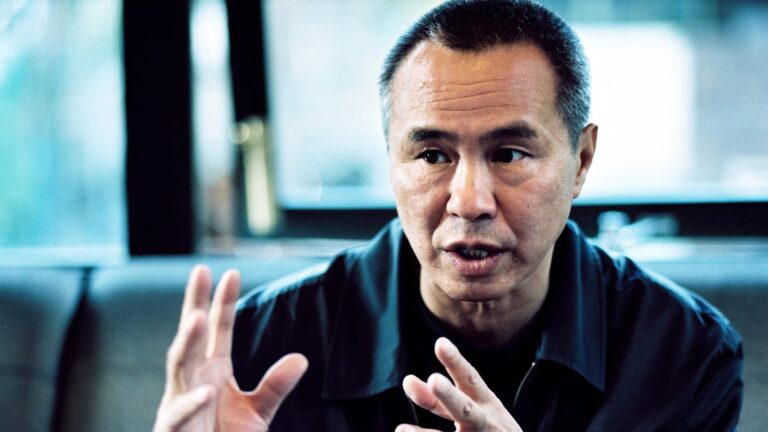
Rouzbeh Rashidi is a filmmaker whose perseverance and seriousness have led film writers in Ireland to regard him as the founder of that country’s most important avant-garde film current. Before his emigration, Rashidi was little seen in Iran, or his works were mostly overlooked on account of their extreme abstraction; but emigration gave him the possibility of bringing the ideas he carried in his head — both in filmmaking and concerning the current he himself has named Experimental Film Society — closer to reality. Rashidi is among the few Iranian artists for whom emigration proved beneficial; how many creative and renowned artists there are of whom, after emigration, neither name nor work remained!
Rashidi came to Tehran in the autumn of 2015 to take part in the series of programmes that had been prepared for EFS. This is my second conversation with him. We first sat down to talk in 2003, in a conversation published in the Mehr weekly, and a year after that Rashidi emigrated to Ireland. Now that nearly twelve years have passed since that conversation, an opportunity arose to review the course he and his society have travelled in these years.
The Experimental Film Society — or EFS, its English abbreviation — is explained sufficiently in the conversation itself.
Please tell us about Experimental Film Society (EFS).
Experimental Film Society is a film collective that I founded in 2000, and it was active in Iran until 2004. From 2004, with my residence in Dublin, Ireland, it naturally transferred there. From 2000 to 2011 the bulk of EFS’s activity was confined to making films, but from then on, as much as we concentrated on making films, we also focused on showing and distributing them — through screenings, through gallery presentation, and through the internet. I can put it this way: a new line of policy was added, which is in fact the very important and fundamental thing that has happened in EFS, and I mostly carry this part myself. The reason is entirely practical: things get done quickly and at the lowest cost. The aims behind this matter are like a personal project for me, and it moves forward with regard to the filmmakers in this collective, with their help, and on the basis of the trust they have in me. This is an outlook I have arrived at, and it works; it may seem strange, but I try to make it like the making of a film or a work of art. In the end one person must decide what should happen. As Béla Tarr says, there must be one person to put the camera here and shoot this way. It is collective work as well. I also like to say that EFS is now a radical space in which a number of filmmakers and visual artists have come together and trust one another. This trust is very organic and natural. It is not something one could inject. I do not know whether I can convey the concept properly or not. Perhaps one of the reasons I cannot describe it properly is that we are together in Ireland — with some we have a long-distance working relation, but our central nucleus has mostly formed in Ireland.
You founded Experimental Film Society yourself in Iran, and it now continues its sixteen-year life, and it has members. But with this radical outlook you describe, how far is it separable from you? In other words, does Experimental Film Society go on without Rouzbeh Rashidi, or does it depend on you entirely?
It does not depend entirely on Rouzbeh Rashidi, because the role of all the filmmakers and their films is important. But this is a project that ends with my death — this is very important to me. Perhaps even while I am still alive I may see that at some point it has to end. It is stress, responsibility and utterly exhausting work, and perhaps in the future that will be the reason for its conclusion.
Of course I did not mean only death!
It is not only death. But if it should happen anyway, I like to determine in advance that this project ends. There is an American critic, writer and film programmer named Amos Vogel who in the 1940s (1947–1963) founded a ciné-club called Cinema 16, and gathered work from Maya Deren, Stan Brakhage, Kenneth Anger and others. He also wrote a book called Film as a Subversive Art, which is a very important book. He said of Cinema 16 that he had wanted to begin a project of some years that would build a culture and show these films. At a certain point he felt he had reached the aim and the initial philosophy he had wanted, and quite consciously — even though Cinema 16 was at the peak of its activities — he decided to dissolve it. A very conscious decision; and after that he devoted his time to writing books and articles.
With regard to EFS, I would like it to be the same: if one day I see that its aims have come to fruition, I will announce its end. So although it has collaborated with artists over these years, it also has personal aspects for me. Indeed, one of the reasons for these artists’ collaboration is having aims in common with me.
I return to your answer to the earlier question — you pointed to the undemocratic character of EFS’s manner. Does this have a practical aspect, or is it entirely theoretical?
First let me open a parenthesis: I could look at this from an ideological standpoint, but I prefer not to. Why? The reason is that everything I say has a practical dimension for me. When I began making films in Iran in the late 1990s, I used to talk with a group of friends, but nothing ever got done! It was very strange. We wanted to make films, but in practice it did not happen. At a certain point I decided to do things myself — and I saw that things got done. I can speak about the practical matters that have happened for EFS across these sixteen years: from showing the works, to planning for a film, to programming, to going out and introducing the films. If a person only wants to sit and talk, work does not necessarily advance; one must economise on energy — these things take time. I am a very orderly person and I like to be so in my work as well; the moment I see that matters are not moving forward, I cancel that project and go after a new one.
So I must say pragmatism is more important to me than theoretical matters. Perhaps I have not even thought very consciously about the theoretical side, but in practice I saw that if I want things to move forward I must do them myself. Over these years it has gone on in this form, and our relations with film curators, museums and cinematheques keep growing. They very much like that one very orderly person carries things forward quickly and can be trusted. I have created this sense of assurance and trust through pragmatism — that is one part of the story. The other part is that I never wanted to build a church where a group of people gather and preach continually. That is why on many occasions I do not use “we”; most of the time I say “I”, because I do not want to speak about others or on behalf of others — even in the EFS statement, which was written with the collaboration of Maximilian Le Cain and Dean Kavanagh, I consciously used “I”.
That was precisely my next question: the society’s statement speaks in your voice, not that of a group with fixed members.
All the elements, events and components in that statement, again, have a practical aspect for me — conclusions, for instance, that I have reached in filmmaking. All of it comes from shortage of budget, from having no support and no sponsor. From having the most rudimentary filmmaking equipment. All of this has happened to me. It was not that I first wrote a manifesto in an abstract space and then tried to bring myself close to it. I overturned that process: a series of events and experiences came my way over these fifteen years, and I tried to turn the important parts of those experiences into a text.
I have a blog called Cinema Thoughts in which I write my view of cinema. I wrote these slowly, five lines at a time, over the years; then I placed these fragments side by side and made a text called “Experimental Film Society Statement: Part 1”. Then a year passed and I saw it was not complete, so I went back to that text and to the other things that had happened to me in filmmaking and film distribution… well, these things happened to me, and where I concluded they could be important, I reflected them in the statement.
As for the members of EFS, I must say that a number of artists trusted me on this road and placed their films at my disposal, and EFS would simply not have formed without them. There are also certain other filmmakers who trusted me up to a point and after a while separated from EFS — no doubt they have taken another path. Because I stand in an extreme space, I like to provoke people, both with my films and with the way I present them; I have never been conservative, I have liked to take risks. Sometimes it has answered well and sometimes not! But I learned things to apply in my later projects. That is, everything has had a critical and unexpected character.
Consequently there is only one way, and that is that I can only speak in the first person in order to carry this EFS project forward, and whatever happens, in the end I am responsible for it. If something bad happens I pay the price myself; if something good happens it helps me carry EFS forward. In truth I have always turned the point of the arrow of attacks back towards myself, and in my view this is the only way EFS can succeed. But at any rate, if we look at my record, these decisions have not been bad.
It is very simple: one can find a few filmmakers and write a manifesto at the very start — but quickly, after a few months, that group falls apart. Because each person speaks their own words; they sit at one table but the think-tank does not work. It is always so. But as I said, I wrote this statement after sixteen years of continuous experience of making, showing and distributing films, with the help of my friends — not at the beginning of the road.
What are the common grounds that have gathered the members of EFS together — both intellectually and technically?
Apart from myself, who founded EFS, there is one other person in the society whom I can even say I trust more than I trust myself. I could perhaps say I regard him in a way as my master. I never had such a feeling; like a loner I always liked to do my own work. But from the time I came to know Maximilian Le Cain, from late 2009, it was as if cold water was poured over a part of my character and my life, and I grew somewhat calm. The feeling that there is someone to trust, someone to consult, someone whose opinion on EFS matters I can ask. I can say that since 2010 we have carried most matters forward as a pair. And this brought me an ease, both in my personal life and professionally. Max, like all of us in EFS, is first of all a cinephile; he is a fine critic whose writings have been published in many places, and — most important of all — an extraordinary filmmaker.
As for the members of EFS, the manner of admission is by invitation. I love watching films as much as I love making them. I always like to see what is happening at the margins — what people have arrived at what personal techniques without necessarily having enormous budgets. I always follow the work of certain filmmakers. For several months, or even a year or two, I quietly follow their works and ask them to send me their new pieces. Then I see that a very particular line of thought has formed in this person, and that EFS can help them. Let me say this plainly: this current always has a radical, extreme character; I never like to work with a filmmaker who lives in very conservative circumstances. So the manner of selection has always been by invitation: some have been friends of mine; a number of filmmakers, musicians and audiovisual artists who also worked with the image; some I met in Ireland. Dean Kavanagh, for instance, I met at university; he showed me his works — in one summer he made ten short films, and the next year he gave them to me. Michael Higgins I came to know through the internet, following his works online; or Jann Clavadetscher, who is a Swiss-Irish filmmaker. EFS at present has nine members. Every day, or every other day, I receive films from filmmakers on the Experimental Film Society Facebook; I watch some and thank the filmmaker, and I try to keep up relations with some of them even if they do not become EFS members. It is very important to be able to build these relations and to exchange screenings.
The form of showing is likewise: we prepare, say, a programme for a film collective in Argentina, and they in turn arrange a programme for us in their country. We do not necessarily take part in festivals — I can even say we keep away from those spaces. We have produced a method of our own in which, first, we do the curatorial thinking ourselves; that is, no programmer comes to say this film should or should not be in. Second, we produce for ourselves a system that guarantees the continuation of our life; otherwise we cannot move forward. This is what makes it possible for us to obtain funding, travel to a country and arrange a programme there in collaboration with a group, while they too obtain funding and come to Ireland. There is a kind of cultural exchange in this method of ours.
As I said, we keep away from the space of film festivals. “Gatekeepers” is an expression in English that is not at all positive; it means those who hold the gate of a place — like those who run the festivals — and we never wanted to pass through that filter. We tried to go around them and set this style of programming in motion.
Let me return to your question of how these filmmakers have gathered together. It is a kind of study that Max and I carry out — that this artist could be interesting and could be in EFS. It is a barter: I am not necessarily doing that filmmaker a favour, nor he me. That is, I profit from that person and he from me. I have no wish at all to dwell in a moralising position, or to say that I have done something very important — no! It is an exchange between the filmmaker and EFS, in this way: EFS’s collection grows, and the filmmaker finds motivation for filmmaking and knows their works will be shown. From 2011 to today EFS has had more than fifty programmes across the world — almost one screening or performance a month — and this itself continually produces motivation. Some institutions welcome it too. And a filmmaker who collaborates with EFS sees there is an incentive to work more.
In EFS we also have a collaborative film project in which several of us make one feature film together. That is, I make thirty minutes and two others make the other sixty; sometimes we set the thirty-minute parts side by side and sometimes we break them up and interleave them. Or another project in which we take the sound of our films and try to build a sound installation. Its source, practically, is our own films, but it shows itself in the category of sound. There are many different paths of collaboration within EFS. If I am talking too much, say so.
No — the questions are general too; if a question arises from your answers along the way, I will ask it.
The questions are such that they provoke one to explain.
Well, doesn’t this collaboration you describe interfere with that radical personal system of yours?
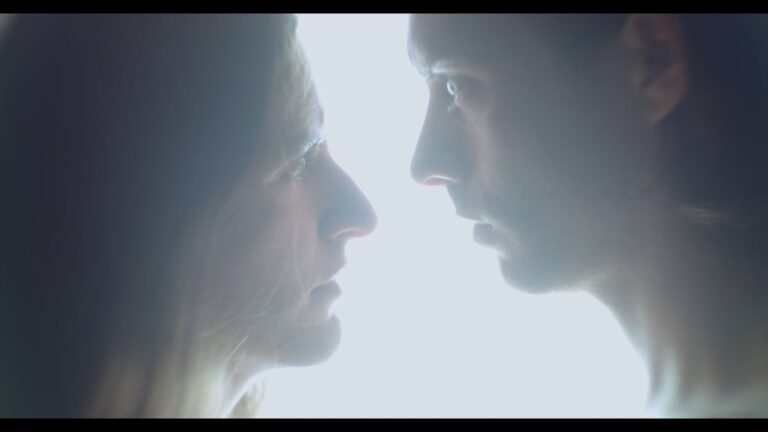
No, for the reason that we have grown so intertwined that in facing one another we, in a sense, do not even think. We go on many residencies: we settle in, set up our equipment and make films. Things happen, and because we are so homogeneous we do not necessarily even have verbal communication. Dean, say, does something for me or I do something for him; we lend each other our lenses; we act in each other’s films. A strange melancholic atmosphere! We shoot rushes for a week, then take the films to Ireland and edit. Sometimes, when the work is to be a joint one, we set them side by side and the film is made. As an example, we made a 95-minute science-fiction film called Forbidden Symmetries, in which human beings and human spaces are shown from the POV of three aliens, and a condition of claustrophobia dominates it. We showed the film at Spectacle in New York and at the Austrian Film Museum in Vienna, and as it happens Nicole Brenez saw it.
To return to the question: when we collaborate, the film finds its own way, and these collaborations can in fact be fruitful. I can say that the films themselves, and the art of cinema, always show us the way and control us.
Explain more about this kind of collaboration.
Our method of filmmaking is not very special or unique; these are methods that have been, and are, experienced by other people — with the proviso, of course, that everyone has their own particular manner: the way of using the camera, the way of directing actors, the way of lighting and so on, which belong to that person alone. But we are filmmakers who always begin with image and sound; it is not that we arrive at the image from a text. We first make contact with sound and image and see what affects us. There are certain raw, general ideas. But we have never felt obliged to begin from a text and reconstruct it. This way of approaching films creates a particular unity in us. Our working process is such that the first phase has an improvised character at the time of shooting, and the editing stage is entirely deliberate. In this method, editing is not merely the arrangement of a predetermined set of shots; it holds the place of the screenplay. I have said many times that the film controls us — that is, the space, the rushes and the very category of cinema have far more influence in us and guide us. Because we are not like Kurosawa, Kubrick or Hitchcock, to know exactly what we want. When capital, a studio and everything are at hand, and you know precisely what you want and you go and reproduce it — that is excellent too. Many of our favourite filmmakers, like Fritz Lang, made films exactly that way. But we truly do not know what we want; it is in the process of production that we understand! It is more like gardening. We scatter a seed, we keep watching, we try to approach it from left and right; sometimes we can and sometimes we cannot. In this process material accumulates; like bricks we slowly lay it up. Editing for us is even more important than shooting; it is there that we arrive at structures and narrative methods.
You touch on an interesting point — so narrative is in your view.
At a discussion session someone asked us: what about when you remove narrative? You can never remove narrative. You always face some degree of narrative, in all the arts. That degree can be very abstract, or brought near point zero, but it is still there. Well, for us it is always the image that builds the narrative, not the reverse. That is, story and screenplay are not necessarily at issue. We call those the solid, iron narrative. Stan Brakhage’s works have a kind of narrative too. People think experimental cinema lacks narrative and everything is necessarily abstract, a series of fast cuts. It is not so at all. To the same degree that a mainstream film can have narrative, an experimental film can too. In the end all of these are cinema, and we need to connect with cinema. Sometimes we draw near that cinematic genre, sometimes this one. To always come and produce a set of quotation marks and build a special space for experimental cinema is a mistake. If we reach the point of saying — this is a film — we can connect quite normally. A fear arises: what is experimental cinema? Yes, it challenges a person precisely and drives them to intellectual searching, but in the end it is a part of cinema. It has a set of classics, and it has bad films too. Serge Daney says: “A cinephile is someone who expects too much of cinema.” From the beginning of cinema’s history these experiments have taken place, and they still exist. It is not that cinema dies with the mobile phone, video and the internet. Cinema — whether with celluloid, with digital, or with the things the future brings — always is and will be; and experimental cinema, of course, is part of it.
In 2009 you joined the Remodernist film movement — that is, you saw your personal thinking, and the thinking on which EFS was founded, as aligned with the Remodernists and with Jesse Richards himself. But after a few years you separated from that current. Tell us about what you shared with the Remodernists and the reasons for parting from that current.
This is a very important question, and I think it can also relate to the earlier ones. Remodernist film has a manifesto that I admire to this day. In truth we found each other through the virtual space. I was in contact with Jesse Richards through private online links, and we watched one another’s work. I became interested in Remodernism, and Richards in EFS. We decided to join together. We made a feature film together. I made another film called Closure of Catharsis and dedicated it to that manifesto. We also made several more short films. Unfortunately this collaboration did not last long — because it had all become a virtual space of email or Skype, since we had never seen each other. We talked constantly, and there was no focal centre, no one person to carry the current forward. Another reason was that so many different people were imposing opinions and tastes that work became impossible. Yet another reason was that the Remodernists insisted on making films with celluloid, while EFS was always one of the encouragers of working with video and digital. We like to connect with the technology of our own age. One can make a film even with a scanner, a mobile phone or anything else that records image and sound. But that does not necessarily mean rejecting celluloid. In EFS, Michael Higgins, Esperanza Collado and, recently, Atoosa Pourhosseini make films specifically with celluloid. Well, Dean Kavanagh and I are attached to digital technology; we like to keep updating ourselves and moving forward with it — and sometimes we also go backwards and work with VHS, Betamax and U-matic. If celluloid is to be used, I myself am very fond of found footage: I go and find reels of 8mm and 16mm — I see you have some too! — and I project them or telecine them and make a film with them. I do not necessarily shoot.
The Remodernists insisted strongly that there must be a return to the poetic cinema of the late fifties and sixties and to Super 8 technology. For me this was very dogmatic. They said video was worthless and artificial — something I did not believe at all, and do not.
So one of the reasons for the separation was the tools of filmmaking?
Yes. As Orson Welles says, what matters is who stands behind the camera — that is, how that thought and that poetic vision stand behind this apparatus. It is not simply a matter of making a film on 8mm or 16mm; the film does not automatically turn out well. It may give a texture that is visually nostalgic and close to Impressionist painting — beautiful! But well, to what extent? How much control can one have over it? Format is always a means, and the filmmaker uses it to express their thoughts. Every format has its own properties, which are very important, and in my view the filmmaker must use the format they love according to their need. It is very simple, and futile insistence on the negative is a very unjustifiable thing. Consequently, after making the film In-Passing we decided to separate from the Remodernists.
Our relationship throughout that whole period was virtual — that is the flaw. When people are to collaborate they must spend time together, live, eat together, and a virtual relationship cannot carry that. One must see the other in order to understand them. Each of us came and made a ten-minute sequence, and these were set side by side, and a film was made in which there was no harmony at all. It was a fruitful two-year period, but in the end we saw that our points in common were few.
Was one of the reasons for the separation not that concept was central to the core of their current and their manifesto?
Exactly — what you say is right. When we spoke about the EFS statement, I said that I did not come and write a statement in 2000; I let fifteen years pass and then wrote it. But Remodernist film, in the very year of its birth, 2008, had a manifesto from the first day.
Though it is customary in human societies for there first to be a constitution or a statement, and then to work on its basis.
Exactly — but I did not want, like the Mormons, to write a manifesto, build a church, and go about saying this is EFS! That is why I keep insisting that EFS is, in the end, a personal way of thinking which a number of filmmakers have trusted. And when that trust is no longer there, and a person changes their mind or consciously decides that they want to work in other circumstances, the relationship ends. It is not necessarily good or bad. We always carry a notion that everything must be permanent and eternal — but it is not so.
In filmmaking, do you prefer form over concept?
In EFS I have come to two conclusions. First, that I am constantly engaged with the history of cinema, and this has always been a lamp in the dark for me; and second, that I am extremely pragmatic. For me and the members of EFS the formalist view is preferred. In other words, we arrive at concept from form.
Earlier in your remarks you spoke about narrative. Even in a person’s simple walking from one point to another, drama takes shape — not the full Aristotelian definition, perhaps, but at the least, narrative takes shape.
Let me give an example: when you listen to John Cage, it is an abstract musical space — you do not ask yourself where its narrative is! Yet people face cinema in such a way that it must always have a beginning, a middle and an end. Now why should a film not be received like Cage’s works? We build you a harmony precisely with rhythm, flicker, noise and all manner of filters. Even like jazz. When you listen to John Coltrane you do not ask yourself what is happening; you surrender yourself to the phenomenon. But in cinema the expectation is always that there should be a hard narrative — whereas cinema can be experienced in very different manners and methods.
We would like our work to be approached like the works of Klaus Schulze. To produce a strange space, and you either entrust yourself to it for an hour or two, or you fight it! Schulze performs an affective auditory experience; our films fall within the same definition. And what happens in the audience’s encounter with the film is not necessarily comprehensible, but it creates a very deep audiovisual effect in the audience, whose force endures.
Now and then, in the encounter of audiences with experimental works, I have heard the nihilist label attached to them. To make the discussion clearer, I ask you: do you have a nihilistic outlook in your films?
By no means. There are many things we do not understand but whose effects we see — like the cosmos. The planets move around the earth and leave their effect upon it; look at the tides. I always try to draw near points that are passing out of the borders of human societies: nature, animals, ruins and wreckage, images received from the microscope or the telescope, and so on. The creation of a very particular space, and the reasoned progression of images and sounds according to a system the filmmaker has designed.
But the human mind fundamentally sets definitions; even if it cannot find a scientific or physical definition, it constructs an ideological one. Do you merely record your surroundings?
No, it is not mere recording. We inject our thinking as well. But, as an example, a closed-circuit camera also has an angle and does not show the whole of reality. Look — fundamentally it is not a question of comprehension and concept and theme; the image itself is rich enough. We always trust the image itself in the first instance, and second, we regard the audience as an intelligent person. We say to them: from a certain point onward, you can work with these images and produce matters of your own. Many filmmakers today say our films are unfinished; I say that my films, on the contrary, are finished — but other layers can be added to them in the encounter with the audience. I could even call it co-creation. When you look at the works of mainstream cinema there is no co-creation; you sit for two hours and everything has been determined for you. You have no place for returning to yourself; but in our films, by virtue of the lack of information and of visual and auditory events, you must constantly refer back to yourself. The tip of this arrow is turned constantly towards the audience and then back towards the film, and this process is constantly reproduced and overturned. Besides affecting your mental system, it affects your body too. You know you are in the cinema hall; you feel the others beside you; sometimes you look around you. You are always aware that you are watching a film, and this is very important to us.
Look — suspension of disbelief is an expression meaning that you forget the real world exists. For us it is not this; for us, the reminder of this current that exists within the hall itself matters. Here is the cinema hall, and you are placed in its midst. When the image goes black, the audience is afraid — why? Because there is no information; it is a void, a strange black hole. That is why blackness matters in experimental cinema. When we watch two hours of film, there are another two hours of blackness within it that our eye does not see. The negative is one frame, a blackness, and again a frame; but because its speed is high you do not see it. Experimental cinema opens up this blackness. It gives the audience an atomic pit into which they may fall and not come out — and if they come out the other side, interesting things happen to them.
Marcel Duchamp says: “It is the viewer who paints the picture.” Do you too give your film’s audience the possibility of seeing and reading it as they wish?
Exactly. In my view the filmmaker can control the film up to a certain point; part of the film must take shape with the audience. Kubrick in Eyes Wide Shut became so obsessive that I do not understand it. Even when he wants to take a simple two-shot of Tom Cruise and Nicole Kidman, the camera must necessarily be at a particular angle. This control and this perfectionism will not necessarily help cinema. One must even, like Jean Eustache, turn cinema backwards — or, like Philippe Garrel, set cinema in motion and return it to its earliest era. Progress does not necessarily mean beauty. We sometimes try to give our films a primitive character. We use low-quality images — images that have been captured and re-captured over and over.
In my view one must first understand what perfection and imperfection are. By these definitions our films are not perfect at all. Max even says always in his interviews that my films are a ruin — like Chernobyl. A place where something happened, and thirty years later its effects are still there. Like Lynch’s films, in which the source of the terror is never seen but its effect is always present. We usually use locations in which civilisation has perished: ruins, half-finished buildings, forests. We try constantly to build a personal world. I myself use space and the galaxy — planets moving in blackness. In our films we have distanced ourselves from intensely human spaces; the role of nature is present in them, and the role of animals likewise. And if we do want to use a person, we place them in an isolated space. These works are not necessarily human-centred; the cosmos and nature matter more to us. We try, like a radio, to see what we can receive.
You spoke about the techniques you use. It seems your effort is knowingly to destroy the clarity of the primary images.
I do not understand white balance and colour correction. Our work is not the reproduction of reality. Reality already is! Suppose I film something and then, in editing and in the colour and light programmes, produce its exact double. I do not understand why one should do such a thing. I do not say it is wrong — I do not understand it! In my view the filmmaker must pick up the camera and see how, in an extreme manner, they can produce something that is not the hair-for-hair copy of reality. There is a set of standard presets a person becomes entangled with when they want to make a film. In that condition neither is the element of chance involved any longer, nor does the accident exist. Everything at its finest is a naturalistic, realistic condition — and then a series of dialogues is spoken in the middle of it. Not the smallest element of mystery, of intellectual challenge, of audiovisual engagement exists in it.
Yet the effort of digital technology is precisely to bring what is recorded closer to reality. Doesn’t your love of indistinct images conflict with digital technology?
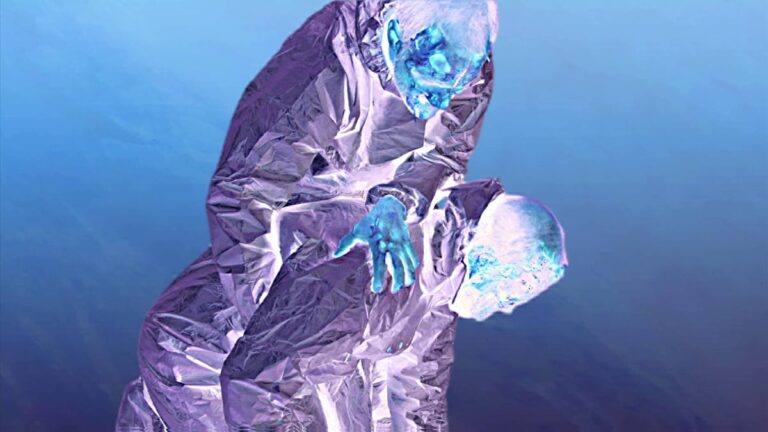
They do not conflict, because we always try to push the camera to the point of destruction. As far as possible we put the camera under pressure to take under-exposed or over-exposed images. Of course we use the standard image too, but within an arrangement. In any case, most of the time in our works the image, the sound, the light and the colour have all been exaggerated. We constantly use flicker — the most violent thing that can be done in cinema, the thing Paul Sharits does. If you have epilepsy it may cause trouble. That is why at the start of programmes we always announce that anyone who has epilepsy, or is sensitive to these things, should leave the hall. It is, at any rate, a risk. Though it is not bad, sometimes, to torture the audience. One must apply a pressure behind which something happens — which is not necessarily liking or disliking. The worst condition is for the audience to be neutral. For us, so far, that has not happened. There must be something that draws the audience out of these norms. Experimental cinema drives the audience towards unknown borders — and that is frightening.
You give definitions of experimental cinema; better to determine whether these definitions are general or personal.
These are not simply definitions of experimental cinema; they are my definitions of experimental cinema. I have said in another interview too that I am not necessarily an experimental filmmaker. But I cannot place myself in any other classification either — I am not a documentarian or a fiction filmmaker. This is a compulsion for me, and not a very pleasant one. To tell the truth, I have grown tired of experimental cinema as well; it is a word that no longer satisfies me. I did not want to be an experimental filmmaker — I only wanted to be a filmmaker, and the nearest space for my works was experimental cinema. You see, the custom that exists for experimental cinema is that a person comes along, makes a film on 16mm, and takes it around the festivals for a year or two. I am not like that; I make many films. Look at most of the film collectives of the world — I do not know about Iran, of course — most work with celluloid, unlike most members of EFS, who make films digitally. I am attached to the feature-length format; the short film no longer satisfies me. Yet most of the classic experimental films of cinema history are shorts. I would like to make features like Pasolini, but with the techniques of Stan Brakhage. But the position of Brakhage and Pasolini is settled. Festivals, too, have no appetite for experimental features — especially beyond seventy minutes. My latest films are three to four hours long. Max, Dean, Michael and I are making a twelve-hour film.
Well, for all that, EFS has arranged programmes in different parts of the world and met with favour — likewise showings in galleries. Is EFS purely a cinematic current?
You see, because of the lack of favour at festivals we are compelled to bind ourselves to cinematheques, galleries, museums and other alternative places. In consequence these purely cinematic definitions are slowly washed away and dissolve.
There is a style called Artist Moving Image — visual artists, in fact, who work with the image. We collaborate a great deal with artists of this kind, like Esperanza Collado and Jason Marsh, who is also a musician and one of the members of EFS. But I myself always liked to be within the format of cinema; I have always been engaged with the history of cinema, and I never accepted that the process of cinema’s formation is finished — in fact I believe cinema can still be built anew. The moment we accept that cinema is dead and finished, we must either set it aside or go into the studio system and work on clichés. But we still love the first currents of cinema’s history; we still believe in the miracle by which, when the train enters the screen, a viewer takes to flight. I like to say that cinema is still magical for me — a magic and a sorcery! An enchantment. Perhaps it is very trite, but cinema has truly been so. A man like Georges Méliès is very important to us. We like to keep surprising ourselves — we succeed or we do not. The question is not how good our films are. We are constantly engaged with these motifs, and we like to reproduce cinema.
Part of EFS’s programmes is in galleries, and this is not confined to film screening: performance art, video art and installation have also become part of EFS’s activities. It seems there are reasons besides compulsion.
By virtue of the qualities some of the EFS artists have, we saw that this possibility exists as well.
You say your sole preoccupation is cinema. So it was on account of the presence of the other artists?
For instance, Esperanza Collado’s specialisation is paracinema and expanded cinema, and she works particularly with 16mm; she makes installations too. Well, I felt this person is engaged with cinema — but in that field.
Let me say this here: in the field of making I am an experimental person, but in the field of showing I am the most classical person on the face of the earth! I like to show my film in a Hollywood-style space with very good seats, an enormous screen and an excellent sound system. Consequently I do not like the gallery space at all — but at the same time I have no choice. But this is me, not the whole group. There are people in EFS who work precisely for these spaces: Maximilian Le Cain, Atoosa Pourhosseini and Esperanza Collado.
So in certain parts you set aside that radical outlook.
I am strict mostly about my own work; as for others, I try very hard to see their work done in the best possible way. I confess, of course, that through these artists my relations with visual art keep growing, and I have entered the field of curating as well.
It seems this compulsion follows you!
Yes — but usually a programmer does not include their own work, whereas I always like to include work of my own. I am a filmmaker and I like my work to be shown. This compulsion you speak of exists; there is also the practical aspect, and the question of which direction EFS wants to move in. If EFS wants to be open, it must accept all these kinds of experience — expanded cinema and paracinema and contact with the world of the visual arts. That is why a man like Max matters, because he has a gallery and museum background and I a cinema background; I think we complete each other.
An audience facing a moving-image work shown in a gallery approaches it with the presupposition of video art — at least in Iran; you too have met this attitude in Iranian galleries. Whereas you consider your works not video art but entirely film. Let me add that there may also be works whose makers worked without any presupposition of medium. Given these explanations, where in your view is the point of divergence between video art and experimental film?
Of my own work I can say that I have always been engaged with the format of cinema. My references, my taste and the manner in which my films are shown have been wholly cinema. But well, visual artists who work with the image like to call themselves video artists or film artists. I have never arrived at where that point lies, and it remains obscure to me; but the manner of presentation, and the place where a work is shown, help greatly in answering your question. If it were up to my taste, I would like to steer everything towards cinema. There is a Thai filmmaker named Apichatpong Weerasethakul who has even taken the Palme d’Or at Cannes for his film Uncle Boonmee Who Can Recall His Past Lives. This man works both for galleries and for museums, but well — he is a filmmaker, and his films are widely released in cinemas.
So cinema can be experienced in the auditorium; it can be experienced in the gallery; it can be experienced even in this very space where we now sit — but it depends on how it is presented. But to say where the point of divergence lies, and to put my finger upon it — I do not know.
Perhaps one could say they have no definite border. What is your view?
No, there is no border. They are woven into one another and move forward together. It is as if a metamorphosis keeps taking place and dissolves the borders. For instance, if we consider specifically the space of showing in a gallery: for me it has been compulsion, and for another it has been deliberate.
And now the last question. In 2015, twelve years after the last screening of your films in Iran (at the Iranian Artists Forum), you presented a screening at the Cinematheque of the Museum of Contemporary Art. Over these years you have also had collaborations with artists inside Iran. Will this interchange between EFS and the artists and artistic currents inside Iran continue?
One hundred per cent. Because a great twelve-year fault-line had opened between me and Iran — even though, when I left, it was by personal desire and inclination, to build an identity for myself and for EFS. Now, I think, that has happened, and I have reached the aims I had in view. Our relations with Iran stand. In any case the distances are great and the tickets expensive, but I would like it to proceed systematically. How far I can carry these things forward — we shall see. Support for artists’ work is very important; it is simple: if there is no financial support, the artist cannot work. If a current or an institution in Iran offers us this support, I would like this relationship to be continuous. In Ireland it is so — we receive support from the state every so often. If it is there — and it is not enormous, of course — we bring artists to Iran and collaborate in different forms; but if it is not, well, the matter does not take shape. EFS’s relation with other countries is the same. At present it is very important to all of us that the organisations which show our works respect the artists and at least cover our costs, because the only means of our livelihood is this art and our films. If this happens systematically, we too will present our works with greater motivation and in the best conditions available.
Notes
- Paracinema — a current that examines genres outside the mainstream of cinema, pursued mostly within experimental cinema; the term was coined by the American media scholar Jeffrey Sconce.
- Expanded cinema — a current alongside cinema, part of which concerns the experience of showing film in unconventional environments; the term was coined by Gene Youngblood.
- Suspension of disbelief — a literary and cinematic term whereby the audience of a visual, auditory or written work willingly sets aside its disbelief in order to attune itself to the world of the text; first used by the English philosopher, poet and aesthetician Samuel Taylor Coleridge in 1817.
Originally published in Persian by EFS Publications following the EFS programmes in Tehran, September–October 2015. Translated into English and republished as a web article in 2026; the Persian source document is preserved in the EFS archive. The original text carried forty-five footnotes, most of which glossed English-language names and terms for the Persian reader; those glosses are redundant in English and have been omitted, while the substantive notes are preserved above.