Cinematic Alchemy: An Interview with Four Members of EFS
By Emmsen Jafari · Translated from the Persian
“I have a bad memory, and I am forever losing the border between reality and imagination; perhaps my films originate there.”
— Michael Higgins
“In the history of art, artists were never deprived of the freedom to express themselves with whatever they chose; but I feel that this is happening now.”
— Esperanza Collado
“I am preoccupied with constructing situations in which the film itself becomes an anti-film.”
— Dean Kavanagh
“If you want to work only for yourself, the work takes on an aspect of art therapy.”
— Atoosa Pourhosseini
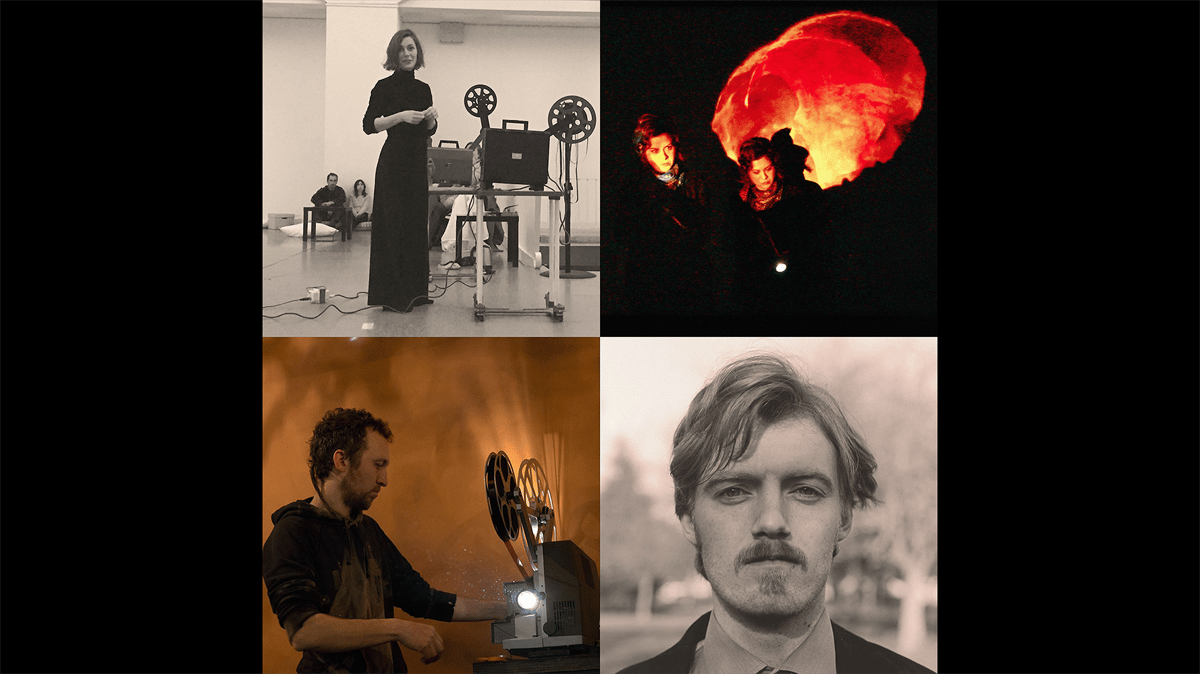
Experimental Film Society (EFS) was founded by Rouzbeh Rashidi in Iran in 2000 and moved to Ireland in 2004 with Rashidi’s emigration. The members of EFS have come together by invitation — a process recounted in detail in the interview with Rouzbeh Rashidi. This is a group conversation with some of the members of EFS: Esperanza Collado (artist, author of Paracinema: la desmaterializacion del cine en las prácticas artísticas and lecturer at the University of Castilla-La Mancha), Michael Higgins (filmmaker and photographer), Dean Kavanagh (filmmaker) and Atoosa Pourhosseini (visual artist and filmmaker). By everyone’s account, Maximilian Le Cain (filmmaker and writer on cinema) was missed here — a figure Rouzbeh Rashidi names as one of the pillars of EFS’s endurance.
In September and October 2015, members of EFS were invited to present programmes in Tehran. These events — film screenings, installation, performance and lectures — took place at the Cinematheque of the Tehran Museum of Contemporary Art, the Lajevardi Foundation, Aaran Projects and the Darbast Platform (Mohsen Gallery).
Regrettably, time and other limitations made it impossible to sit down with each of these artists one by one, so a group conversation was decided upon.
Ms Esperanza Collado, you recently gave two performances in Tehran (at the Lajevardi Foundation): the first a lecture which, through its staging and mode of delivery, became a performance; the second a piece from the Operation Rewrite series entitled Exterior/Night. Tell us a little about these two performances, and in particular about Operation Rewrite, the project you share with Maximilian Le Cain.
Esperanza Collado: In Operation Rewrite, and particularly in 45:37, we set an empty space in place and used various techniques so that the work would remain open-ended and unfinished. The whole project, from a perceptual point of view, revolves between cinematographic montage and works of reading/writing. So there is a mental engagement between the presence of the viewer/spectator and their agency within the work. In Things Once Said there is that quotation from Hollis Frampton which says: “In the projection of a film we see an image of only half of what has taken place, because the camera’s diaphragm shuts out the other half.” This is the very empty space, the black scene, towards which we move — a phenomenon that has also been found in the structure of language.
Exterior, Night — the performance we presented at the Lajevardi Foundation — was physically altered by the audience. We had to pass through the audience and through that space, and the use of darkness lent the act a particular energy. There was a moment when I began to applaud before the audience did, looking at them directly. We did not know how the audience would respond.
In my solo works, and in my recent performances, the audience is an essential part of the realisation of the work. These tensions exist — this sense of temporal continuity, of communicative space and presence — and I am eager to explore them further.
You work in the field of expanded cinema. How can cinema be carried into the gallery, or into other spaces?
Esperanza Collado: I cannot explain this concept in two sentences; I need more time. I am aware that what I do is expanded cinema, but it has very broad aspects and cannot be looked at so simply. For me it is not merely a question of expanded cinema: I try to engage with the elements of cinema, with situations, with possibilities, and with the fact that cinema can be presented in different places. My preoccupation is with how cinema can be experienced in conditions other than the standard one we know. The reason I turned to performance is a very practical one. In Dublin I used to curate programmes where I myself had to stand before the audience and enter into conversation with them, then go behind the projector and perform the act of projection — and this process, in which you are curating something, speaking and projecting, itself becomes a performance. I showed films from the history of cinema there, and ultimately they were me — even when I was showing films by other filmmakers, it was still my own preoccupation. The manner and arrangement in which I placed these films side by side was something that revealed my own person. It is true that I used films that belonged to other directors, but the way I presented them, the way I set them alongside one another and the way I explained them to the audience turned it, in the end, into a personal work. The material comes from elsewhere, but it finally becomes a personal work. And one of the reasons it became a collective matter was that I was not working with state institutions; everything happened in an informal space and I had the opportunity to connect with the audience. This closeness to the audience was very important to me — and it all comes back to the question of performance.
Finally, I want to close my answer this way: when I began presenting these programmes, I saw that there were signs of choreography in them, and that it was not at all a usual state of affairs. Everything that happened — the relations passing between me, the space, the films and the audience — had turned into a kind of performance art with a dance-like quality, because I had to come and go, and in all of this I was using my body. At first I had no awareness of it and had not noticed it, but later I understood that this was performance, and I tried to use it as a launching pad to arrive at the performances I make now.
The point you all share is your activity in experimental cinema. Is experimental cinema — not in its student sense, where it is merely trial and error and the product of a sweet excitement, but the cinema whose celebrated filmmakers are Brakhage, Pat O’Neill and Will Hindle — without rules?
Michael Higgins: When I first encountered experimental cinema I saw that filmmaking could have other aspects too, and that I could express myself with greater freedom. But in experimental cinema there is a lack, a shortage, of rules.
Esperanza Collado: I believe rules can exist according to each project — like my Operation Rewrite project, which had a set of laws within it, because if they are not there, anyone can do whatever they please. We must keep tightening the arrow until we reach a fine point, and if those rules had not existed I could not have arrived at this form.
Dean Kavanagh: For me format is very important — how I can work with the tools I have — and I want, entirely, to reach a facet that is completely unknown, whether in my own work or in the work of others. I am constantly seeking access to how this whole apparatus at my disposal can be brought to a state that is enigmatic and strange. I know I have not answered your question very well, but I think it is better if I approach it this way: how to carry this equipment, this format, this technology at my disposal towards somewhere unknown.
Atoosa Pourhosseini: All experimental filmmakers — Paul Sharits, Michael Snow or Chantal Akerman among them — have their own distinct rules and characteristics. The same holds for us. In any case, when you are in contact with this style of art you need to study constantly and watch the works; in the end you come to know the rules, and along the way you arrive at your own personal methods and laws as well.
Given these explanations, where does the audience stand when facing experimental cinema?
Atoosa Pourhosseini: I do not believe in fixing and limiting the position of the audience. Generally, when I make a work, the first thing that matters to me is what relationship I form with my own work — I must be satisfied with it myself, and in agreement with it. At the next stage the opinions of colleagues I trust matter; but I hold the belief that the work is completed with the audience. When you produce a work, it is with the mind of the audience that it is completed and can come to an end — because, to my mind, if you want to work only for yourself it takes on an aspect of art therapy, whereas when you share it with an audience, the audience makes its own reading. I keep away those fences that decree what this work is and what it is not. Every time we hold a screening or an exhibition, it is interesting for me to see how each person makes a reading of the work in their own right. The difference between readings means that each person completes the work with their own background of thought.
Michael Higgins: Throughout the process of making my films I try to place myself continually in the position of the audience, to see what happens and how they might encounter the work — but in the end I never quite succeed, because I do not know who they are or where they are, and this is very subjective; it can only be understood up to a point. For that reason I try, as far as I can, to understand what the audience is, but at a certain point it passes beyond my power.
Esperanza Collado: In my view, a work acquires objective existence when it is offered to an audience. Naturally, because my work lies mostly in the field of performance, the presence of the audience in it is always strong, and I try to present certain forms of editing within space, place and the audience’s presence; and audiences always have the freedom, in encountering my work, to work with these elements and see what happens. I also create a very open space, and I want to see what effect that performance and that openness have on the audience. For example, in the lecture I gave at the Lajevardi Foundation, the method I used was to say as little as possible. If you look at the text of that performance, printed in its booklet, there were empty spaces left for the audience to fill. It is very important to me to give the audience this space and this possibility, and to see how they can enter the current. Involving the audience in this situation is very important.
Dean Kavanagh: Many people think experimental cinema pays no attention whatsoever to the audience. I strongly disagree — because I believe it is mainstream, popular cinema that has set the audience aside and wants to hold no conversation at all, whereas it is experimental cinema that gives the audience this opportunity and this possibility. For instance, the best way to prevent pregnancy is for there to be no relationship at all — and that resembles the relation of mainstream cinema to its audience. Experimental cinema, however, respects the audience and involves them. Filmmaking is a bridge between me and the audience. If there were another way to communicate with the audience very clearly and directly, I would certainly do it; but for me there is no other way. So this act of sharing the work with the audience is very important to me, and I always think of my audiences. In a way, all of us make films that creep quietly into the personal world of the viewer. At first they may resist the encounter, but in the end these films find their way and enter the personal world of their audiences.
Esperanza Collado: We should also bear in mind that we ourselves are the audience of other people’s works, and we have learned from them. An experience we learned, and now want to share in. It is an exchange, and the positions change constantly. It is not that we stand in some distant space.
Mr Higgins, the subject in your films seems to lose its essence — as in Filament. Tell us about this de-essentialising in your films.
Michael Higgins: Yes, I agree; that is what happens. For me the drowsy narration between nightmare and dream is important. I am always moving between these two worlds, and things happen that I try to express through my films. This condition — this stripping of essence you speak of — is produced in the encounter with the films. I should add this too: what we do not show, what we do not film, what we do not share with the audience, is exactly as important as the things we show. I must insist — I do not like to use the word truth, it has been much cheapened — but well, between the things we show and the things we do not show there is a balance: how near one can draw to that truth, or how far from it.
I should mention the use of celluloid, and the way I use 16mm or 8mm. When I approach that style and use those instruments and that kind of film stock, it performs a series of operations for me automatically. Images are created, and this choice brings certain things into the work. I work with digital too, but I lean more towards the other side, because it puts possibilities at my disposal that I find very interesting.
I have a bad memory, and I am forever losing the border between reality and imagination; perhaps my films originate there. Someone once said somewhere: “If it is not recorded, it does not exist.” I sometimes use this formula; I try to present my films that way. Forgetting the border of what is reality and what is not, what is dream and what is nightmare — that is important to me.
Ms Pourhosseini, you are a visual artist. You trained in painting and then turned to video and film. Although a change of medium is entirely natural today, tell us how this passage unfolded for you.
Atoosa Pourhosseini: I have a ten-year background in painting, drawing, colour, human anatomy and figurative work. That knowledge took shape in Iran through two masters I had, in their private studios, and likewise at university. But from the moment I entered Ireland everything changed, and I felt this change had to occur in my work as well, because I regard life and work as one. There I tried to turn towards abstract art, and movement and sound became important to me. I began with animation, about which, admittedly, I did not have much knowledge: I tried to scan the paintings, drawings and photographs I was making, or to use stop-motion, placing them side by side to create a slight, delicate movement. This in fact began in 2011. Then I concentrated on sound, noise art and soundscape, and it went on this way until it came to include several audio-video works, then installation and performance. At present, film and celluloid have become interesting to me, and I am working on Super 8.
In Ireland you collaborate with the group Strange Attractor. How did this collaboration take shape?
Atoosa Pourhosseini: Through a residency I did in Cork in 2013, I met Mick O’Shea (director of the residency and a member of Strange Attractor), though I had been following their work before that. Some members of this group have visual-art experience, particularly in drawing and sculpture, and that was our common ground. It was very appealing to me to approach sound by this route, and this led to collaborations between us in performance, mostly improvised. The result has been four performances in galleries and at a festival in Cork and Dublin, which we have done together from 2013 until now. Like Dean, I find it interesting to work with material that is somewhat less known to me, and to have the curiosity to discover it.
Sound undergoes metamorphosis in your films — from the optical soundtrack of the negative to noises obtained from location sound and even from music. How is sound defined in your films?
Dean Kavanagh: I play guitar and other instruments myself, and I always try to bring them into my films, but it really cannot be done — they take on too surface a quality. So I try to work on the sounds they produce and to draw them out of the sonic situations they inhabit. Because — at least for me — it is always the image that produces the sound and says where the sound should be. Once that has happened, the process can be reversed, and the sound can say what the next image is. There must always be a passage between the two. I work digitally, and the way I use sound has an entirely separate nature from celluloid. It is not like film stock, which carries things upon itself in the very moment; usually the sound is prepared afterwards and fitted onto the film. In recent years the films I have made have all been digital, and that in itself brings a certain aesthetic into the film; but the sounds I have laid over these films are sounds that go back to the earliest era of cinema’s history — the sound of a gramophone record, or sounds produced from celluloid and negative. Yet this holds no nostalgia for me. When you deal with digital, sound is entirely separate — no law exists — so why not exploit it, as format, to infinity?! Sound for me has a strongly formal character, and at the same time it is foreign to me.
Esperanza Collado: Sound is very important to me — I might even say more than the image. I try, as far as possible, to put even the image in second place. Its manner of presence and its manner of use are, I might say, the most important thing. For instance The Illuminating Gas, which was screened at the Cinematheque, is a film that wants to discover and experience the presence of sound. I am practically engaged all the time with all manner of different sounds, and this is something that sits optically on the film. I would very much have liked to discover that sound completely. I agree with the definition that sound and image are two separate categories, each with its own workings. When I project an image the sound of the projector is always there; I try to keep it. Sometimes I play sounds from other sources, which have their own other functions. But they are always an independent element with their own particular nature. It matters to me that sounds are a completely independent unit in time. They have their own nature, character and place. It is not necessarily the case that one is chained to the other; they are all separate.
Michael Higgins: That cinema has the capacity to separate sound and image is very attractive to me. But there are times when I use music in my feature films — music, after all, is also sound. There is a musician I have been working with for a long time. The form of our collaboration is that I give him some material, he works on it and sends it back to me, and I work on it again. There is a close collaboration between us. The way we use sound and music is very interesting to us. I admire his work greatly; the sounds he produces set strange things in motion in me, and they help my feature film. For me it depends on what the project is — a short film or a feature?
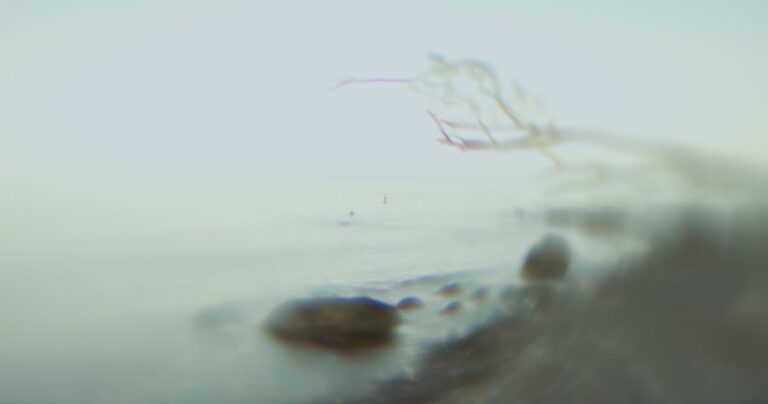
Atoosa Pourhosseini: Usually in my works, image and sound have their own narration and their own particular function. That is, sound and image do not necessarily coincide in time; rather they complete one another in a dialectical manner. Likewise, for me it depends on each project — but well, let me speak of the two works shown in Iran. For the piece installed at Aaran Projects, called Last Phase, I shot the images, and since my preoccupation was how to transfer drawing into the moving image, I edited the rushes and then decided to use the resources of drawing for its sound — playing with sand, and likewise the sound of charcoal drawn across paper. Clandestine, the film screened at the Cinematheque, had a more complex structure. The images I shot on Super 8 were from two different countries, and the inspiration I took from the surroundings was decisive — especially the solitude and silence I experienced in Estonia, which had a strange quality for me. I tried to see how I could bring that eerie sound into the film. I recorded some sounds myself. The work was shown as a film at the Cinematheque, but earlier it had also been performed with the collaboration of Irene Murphy and Mick O’Shea. In that performance they improvised the sound part, which was recorded, and afterwards I edited all the material I had from Mick, Irene and myself and brought it into the film as another layer. I should also mention that in Estonia I thought a great deal about Tarkovsky, because he had shot Stalker there, and I kept thinking about this; it was a powerful reference for me and deeply influential.
Mr Higgins, you build your own pinhole cameras and record images with them. It seems you are trying to make your tools ever more personal. Is the reason simply a personalisation running from tool to work, or is there another reason?
Michael Higgins: This question of personalisation is very important to me, and it keeps growing — and I am glad of it. I must emphasise that I always like to work with tools and equipment that are finally under my own control. Another point is that on celluloid the element of chance is very important to me: when I build these tools, just as I have control over them, the element of chance also enters the process. In some cases it has an image function, in others a sound function, and I use both. So this process of carrying my work forward with the equipment I use — this personalisation you mention — is very important to me, and it keeps increasing. Many of the films I make are films of the road, and they have moved away from my personal life. When you are in contact with this style of filmmaking, a whole series of things happens to you unbidden. Take, for example, the pinhole camera I built by virtue of being in Iran, in that particular time and place. The time and place you are in bring things to you, and you must accept them with an open mind; on their basis, reactions arise in you that may sometimes end in the building of a tool and sometimes in the making of a particular film. There are things that are not merely myself — that time and that location bring them with them. And what Dean said is very important: you have had an experience in special, particular circumstances, and you want to share it with audiences. In my view this personalisation must take place; otherwise it turns into something resembling mainstream cinema.
Ms Collado, your devotion to analogue filmmaking goes so far that you even use a film projector to show your works. Is this devotion merely a matter of tools and material, or is it that you cannot get along with digital filmmaking?
Esperanza Collado: This is what I referred to at the beginning. When I was curating and showing those films — experimental films from the history of cinema — those films were on celluloid, so it all comes back to the practical nature of the things I was doing; those films struck a spark in me that is with me still. I hold no front and no hostility against the digital; I use it, and if digital did not exist I would not know what to do.
I ask because, at the question-and-answer session at the Cinematheque of the Museum of Contemporary Art, Mr Rashidi said that you were not satisfied with your film being shown digitally.
Esperanza Collado: I must certainly say this: digital and analogue are two entirely different media. It is true that in the end you see an image, but the experience, and the manner in which those images are presented, are entirely different; and for me the act of projecting an image with an analogue projector, at that particular speed, is very important. When I project, it is not merely the image fallen on the wall that matters — a smooth, flat thing. The machine itself present in that space, the film passing from one reel into another, the sound that is heard: all of these join hands and construct a particular experience for a person, and if we remove them it is not only the image that suffers the change. All of these matter to me.
In recent years analogue production has declined and grows fainter and fainter, and the cost of producing these films grows higher and higher; practically a situation has arisen in which one cannot work — it has become very hard; the negative is being erased from the history of cinema altogether. So this is a motivation for me, and I try, as long as these factories are working and have not gone bankrupt, as long as this material exists on the market, to gain access to it and to work. The second reason is that the system that now exists is a completely totalitarian commercial system: it keeps handing you new technology, and by the time you try to grow close to any one of these technologies another technology comes to market — you cannot decide at all. It has become purely commercial. Well, film for me is a thing with history behind it. I want to use it as far as possible, before it disappears completely and dies.
In the history of art, artists were never deprived of the freedom to express themselves with whatever they chose; but I feel that this is happening now. I love this format and this style of filmmaking, and this choice is being taken from me — and that is simply not right. I fight as far as possible to keep access to these things; I feel this right is being violated and I want to resist it. Clearly, as far as one can, one must pay certain ransoms and wage certain struggles — a space between the two.
Michael Higgins: Along the lines of this question, and of the earlier one put to me, I should mention that the way I built a pinhole camera in Iran was by finding cardboard and tape in a rubbish bin. It can be built easily; whereas the technology Esperanza describes is such that it is forever newer and newer, and I feel there is a strange wastefulness in the digital. Whereas you can do your work with other means and other resources. When you work digitally you can record hours of images with no control over them; in analogue it is not so — you can shoot thirty minutes, and that is precious. You must express yourself within that span of time; this constraint it builds for you is good, and it produces creativity. I believe you can still use this technology, which has lived for fifty years — but the digital has a very short life.
Mr Kavanagh, when as a filmmaker you take other people’s footage — whether personal, promotional or feature material — as the basis of your work, what process do you pass through to personalise and appropriate it?
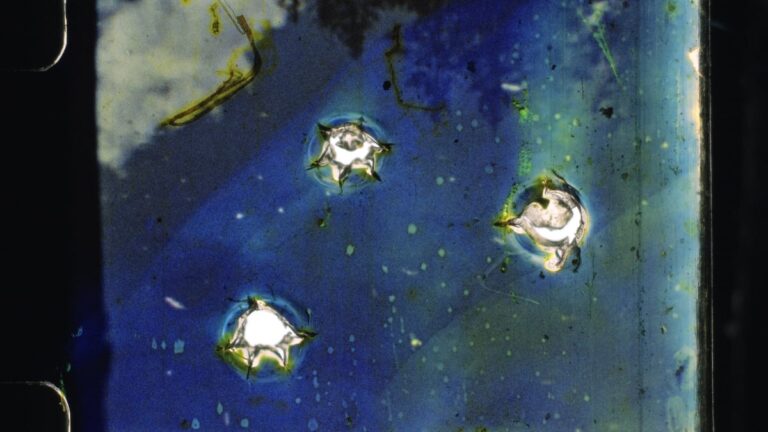
Dean Kavanagh: Financially, and in terms of production, I have no access to 35mm, and for lack of budget I must take refuge in these routes to be able to make my film — there is no choice. All of this is due to financial matters. So I try to take up archival images and use them. I analyse them continually; I subject them to a series of technical processes until they arrive at a personal form. It is entirely practical. Most of the time the material one finds is a low-quality copy of its original version — so what am I to do? I cannot use them as they are, so I must degrade them anew. Even if I gain access to a set of high-quality images and telecine them myself, I still feel a strangeness towards them, because again they are not mine. I must perform some work on these images to reach the thing I want. That can proceed from a lack of quality, or even from high quality. I must bring this material to somewhere between these two states, to a place like limbo. Archival images have this property: they are made for one purpose and then set aside — they have a disposable character. A film is made for television, say, and after a while it is forgotten. I find them, keep them somewhere, and over time convert them from format to format; their quality is likewise worn away until they arrive at a point of being utterly orphaned. So while the passage of time has already worked its reactions upon them, I too, with chemical means, deliver them to a new station. A kind of cinematic alchemy. It saddens me to see them come to no destiny — so in the end I bring a hammer down on them, to set a fingerprint of my own upon them, so that I might perhaps carry them to some destiny rather than leave them lying untouched somewhere.
Rouzbeh Rashidi said in one of the films of the Homo Sapiens Project: “Anything in this life that you want understood, you must film and turn into cinema.” Perhaps I am the same. I must myself experience the converting of things, the setting of a fingerprint upon them, in order to understand them. A thing that is wholly realistic is of no use; we must begin to carry it somewhere again through the alchemy of filmmaking, if we want to deal with this matter very personally — because our work is not the reproduction of reality, for reality already is. We want to overturn a project in order to arrive at something else.
I ask this because, in the films I have seen from EFS so far, the element of narrative is more pronounced in yours. Do you have a definite plan for your films, or do you record images in the encounter with subject and place and give them shape at the editing stage?
Dean Kavanagh: I can say there is nothing resembling a screenplay. Every project differs from the next. I shoot first — sometimes it is more improvised, and sometimes, as it happens, highly considered. Sometimes what I want comes out, and sometimes the reverse — what I want does not come out; and most of the time, what does not come out is more interesting to me. Sometimes I shoot and see that the image coming out of the camera is not interesting, and then in editing I work changes upon it. Editing for me is like screenwriting: many of the decisions are taken there, and it is an important process.
If you were to look at the course of my development: at first I had a semi-romantic attitude towards filmmaking, and as I went forward this attitude faded. It is as if I made a circle — as if I watched the films from where they are, then came round behind the projector and looked at them from there; and in this process of change and transformation the romantic quality was worn away, and now I have drawn nearer to a formalist space, and it is constantly changing — but in the end these things have become interwoven and produced an amalgam, which is what my works can now be. The films I make differ from those of the other EFS filmmakers in this respect: I try to have them destroy themselves from within. I construct situations in which the films, like termites, gnaw at themselves from inside, devour themselves and collapse — and perhaps it is here that the way I approach narrative differs from the way the others deal with narrative. I am forever preoccupied with constructing situations in which the film itself becomes an anti-film.
How is your relationship with EFS, as filmmakers, defined?
Michael Higgins: EFS gives me the daring and the assurance to do things I could not otherwise do. It has shown me a green light. There are places where I have doubts, and when I am within EFS those doubts dissolve. That is very positive for me. The network of support that exists in this system is very important, and I take pleasure in it. I am in personal contact with all the members; but the very fact of knowing that EFS exists is like a station, or an umbrella I can step beneath.
Esperanza Collado: My position differs somewhat, because I have not lived in Ireland for years. Once, a respected magazine in Spain called Lumière asked me why I collaborate with EFS when my work is so different from theirs. The answer I gave the magazine was that it is true my work is different, but other aspects of EFS interest me — the same things Michael and Dean described: the support, the relationships we have with one another, the way we carry our projects forward, the way we make films and show them. The first time, it was Maximilian Le Cain who showed me the films of Dean and Rouzbeh, and they interested me; Michael I know by another route. Max’s place here is a special one, since he and I collaborate closely on personal projects. It was he who played the part in acquainting me with EFS. I work on projects that cannot be shown in an ordinary cinema situation and that need a performative space. It might seem that I am a stranger in this group, but the form in which we work together — such as the project we did in Iran — refutes this, and shows that each of us, with the personal and working traits we have, can work together. The programme I saw at the Cinematheque in Tehran is perhaps the most complete programme I have seen from EFS to this day. I felt it was one feature film broken into short, short sequences. I have seen other EFS programmes, but this one is for me an emblem of maturation — that EFS has now arrived here. I am very glad, and I feel there is a strong harmony in this group.
Atoosa Pourhosseini: My entry into Experimental Film Society happened without any decision-making; it had a natural form, which again goes back to the fact that over the past five years I took part continually in most of the programmes. Every one of the members and projects held an attraction for me; I was influenced by Operation Rewrite, Esperanza and Max’s project, and I collaborated with Rouzbeh, Dean and Max on several projects; without my noticing, a very close bond came into being. To my mind there is a particular energy, daring and assurance in this group, and it has always been deeply satisfying.
Dean Kavanagh: I want to add this: the films we make — I will go so far as to say it — would be impossible without EFS. A space and an energy beneath which we all move.
Michael Higgins: It is a family.
Thank you for the time you have given. Certainly it would have been possible to speak with each of you separately; some of these questions were common to you all, perhaps a question was asked of one of you that could equally have been asked of another, and some of your answers raised further questions which, regrettably, the limits of time did not allow.
Notes
- Operation Rewrite — a joint project between Esperanza Collado and Maximilian Le Cain.
- Exterior, Night — one of the performances of the Operation Rewrite project, presented in September 2015 at the Lajevardi Foundation, Tehran.
- 45:37 — a joint project between Esperanza Collado and Maximilian Le Cain.
- Things Once Said — a text on cinema by Esperanza Collado, presented as a lecture-performance in September 2015 at the Lajevardi Foundation, Tehran.
- Expanded cinema — a current alongside cinema, part of which concerns the experience of showing film in unconventional environments; the term was coined by Gene Youngblood.
- Strange Attractor — an Irish group working in the field of sound art.
- Homo Sapiens Project — a film project of Experimental Film Society.
- Lumière — a film journal published in Spain.
Originally published in Persian by EFS Publications following the EFS programmes in Tehran, September–October 2015. Translated into English and republished as a web article in 2026; the Persian source document is preserved in the EFS archive. The original text carried thirty-three footnotes, most of which glossed English-language names and terms for the Persian reader; those glosses are redundant in English and have been omitted, while the substantive notes are preserved above.