
Experimental Film Society · Homo Sapiens Project
Homo Sapiens Project, Volume 19
As part of the Homo Sapiens Project · comprising instalments 181–190
The Installments
Lilac blossoms drift across a fjord’s still water, two landscapes agreeing to share one frame.
A grid of four rooms: red curtain, black static, sleeping pigs, and a row of empty hooks.
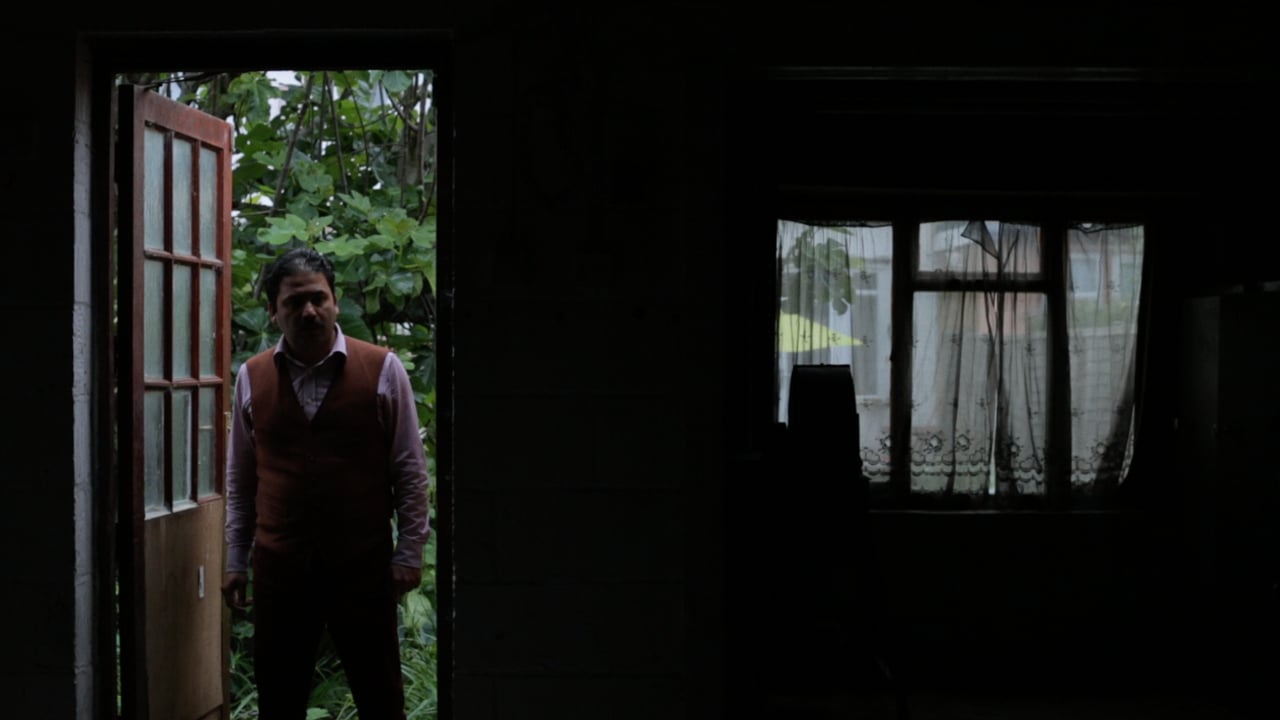
A man stands in the lit doorway of a dark house, the garden behind him arguing for departure.
In sun-shattered woodland a man shields his eyes, the light arriving in coins and blades.
Twice over in blue: a moustached man in a cap beside vines, keeping both his appointments.
Over a dusk-blue town, a window layers its own recollections — a candle, a face, the roofs.
Panels of noise and vacancy around one small remembered field — the archive down to its last view.
A parlour of paintings, a green surveillance inset, and small loaves glowing by firelight — one evening in three currencies.
A charred, twisted relic presented on the table’s wood grain, the day’s finding from an unnamed fire.
A hooded silhouette waits at the curtained window, patient as furniture that has learned to stand.
Synopsis
The Homo Sapiens Project is less a body of films than a single, unclosing organism of moving images — a laboratory in which cinema is turned upon itself and made to ask what it can think, feel, and reveal once relieved of story, psychology, and the sovereignty of the human eye. Perception itself becomes the reagent: sound and image are laid down first, and sense is allowed to drift outward from them rather than be illustrated into them. Time does not advance toward resolution but thickens into duration, an elliptical present that loops and returns until the frame ceases to point beyond itself and simply is — a living cell of reality, luminous and opaque at once. Through it moves a gaze that is not quite human, an impersonal, almost extraterrestrial attention that surveys flesh, landscape, architecture, and light with cold fascination, until the familiar turns eerie and the human dwindles to one object among objects. What it offers is not knowledge stated but knowledge undergone — dread, trance, rapture, the shock of darkness broken by sudden light — a passage through matter, memory, and hallucination in which narrative certainty dissolves and something older and stranger surfaces in its place. It is filmmaking as a parallel to living: a thinking-through of cinema conducted at the very limits of what the image can hold.
Director’s Statement
The Homo Sapiens Project is the distillation and, in some measure, the culmination of Rouzbeh Rashidi’s cinema. The director approaches the moving image as a laboratory and each work as an experiment in which his own perception and inner life are employed as a reagent. He begins not with a story to be told but with sound and image, working intuitively outward toward ideas and treating the making of images as exploration rather than illustration — a practice deeply engaged with the history and material of film, yet bent on collapsing the boundary between alienated subjective perception and the inexhaustible mysteriousness of the moving image.
His method is a sustained withdrawal from the securities of narrative cinema. Rashidi refuses illustration, psychology, dramatic explanation, and the reassurances of conventional narration, pursuing instead a ground zero of drama in which the image is stripped of its obligation to mean. Time is emptied of teleology and given over to duration — elliptical, recursive, held open — so that each frame is released from the demand to lead somewhere and permitted to exist for itself. Meaning is never delivered; it is deposited, and crystallises, if at all, in the act of viewing.
At the centre of the work is a gaze that is not centred on the human at all. The camera becomes an impersonal, quasi-autonomous intelligence — an alien vantage that studies bodies, faces, landscapes, and machines without entering into their motives, until the everyday is estranged and rendered eerie. The human figure, the director’s own included, appears not as the bearer of meaning but as one object among objects, absorbed into the immanent texture of the image. The frame asserts its own ontology: not a window onto reality but a plane of reality itself, matter and light left to think on their own terms.
These films do not convey ideas so much as embody them. They act upon the viewer through affect and sensation — dread, trance, rapture, the visceral force of grain, flicker, and drone, the alternation of darkness with sudden, overexposing light. The knowledge they yield is corporeal and processual, undergone rather than stated. Working across an unusually wide range of imaging instruments, from obsolete analogue apparatus to the most advanced digital and optical devices, Rashidi treats each technology as an organ of perception, a means of testing what the image can register at the threshold of human legibility.
Taken whole, the Homo Sapiens Project is filmmaking conceived as a parallel to living — not a life filmed, but a thinking-through of cinema that runs alongside existence. It is an open and unclosing inquiry into what film can become when driven to its limits: a cinema that does not depict a philosophy from outside but generates one immanently, through montage, light, duration, and sound. Its wager is that the image can always think more, feel more, and reveal more — that the limits of cinema have not yet been tested enough.