Pantalla Fantasma Festival (2015)
By Julius Richard
January 19–24, Espacio Puerta, Bilbao
Touring to: Tabakalera (San Sebastián), CA2M (Móstoles, Madrid), MUSAC (León), The Guesthouse (Cork, Ireland)
What is cinema?
Eyes and phantoms.
Saint Augustin
Pantalla Fantasma is a show.
To show is not the same as to say.
Pantalla Fantasma is a weirdo/outer limits film festival.
A word, a phantom (Celan).
Thousands of phantoms are strung together here.
Pantalla Fantasma reaches its Fourth Edition.
Pantalla Fantasma reaches Bilbao.
Pantalla Fantasma reaches Madrid.
Pantalla Fantasma reaches León.
Pantalla Fantasma reaches Donostia.
Pantalla Fantasma reaches Cork, Ireland.
Pantalla Fantasma reaches the limit.
Pantalla Fantasma reaches strangeness.
Cinema — eyes and phantoms — in the presence of an absence.
The margin is the absence of the centre.
The opposite of existence is not nonexistence.
The opposite of existence is insistence.
The opposite of the centre is not the periphery.
The opposite of the centre is the centre itself.
The centre is everywhere.
The periphery is nowhere.
There is the periphery and there are peripheries.
There are margins and there are margins.
There are centres and there are centres.
Pantalla Fantasma has a centre.
A heart-core.
Pantalla Fantasma holds the centre.
Pantalla Fantasma exhausts words.
Goodbye to Language.
Point 7 of Pantalla Fantasma.
Pantalla Fantasma is a commerce of phantoms.
Pantalla Fantasma is a Phantology convention.
Pantalla Fantasma is metaphor.
Pantalla Fantasma is nature.
Being and not being.
Pantalla Fantasma is a door. (1)
Spectres, like cinema, live by repetition.
They repeat because they are repressed because they repeat.
In Greek, and not only in Greek, phantom designates image and ghost.
The phantom is a spectre (Derrida, Cinema and Its Phantoms).
Spectres and phantoms of the past, exemplars and examples: Xurxo Chirro, Virginia García del Pino, Jess Franco, Damon Packard, Andrés Duque, Agnès Pe. Thomas, Ramón Churruca, Pablo Mars, Bob Moricz, Marion Cross, Irantzu Sanzo, Sandra Cuesta, one self.
Spectres and phantoms of the present, exemplars and examples: Deborah Stratman, Rubén García López, Sean Brown, Dean Kavanagh, Michael Higgins, Rouzbeh Rashidi, Carlos Serrano Azcona, Juan Carlos Gallardo, Inés García, Arcadi Ballester, Canódromo Abandonado.
“It’s SCREEN (‘pantalla’) because it is conceived as an audiovisual exploration that detects what happens at the boundaries of a zone of light.”
An adventure in perception: cinema as exploration.
“It’s PHANTOM (‘fantasma’) because it assumes the attitude of a ‘phantom’ in aspiring for something unattainable, without fear of being overwhelmed by the medium.”
Risking the impossible: let a man come from the tomb.
What is man?
Eyes and phantoms.
Who is the man?
Jorge Núñez.
Jorge Núñez is a man.
Jorge Núñez is a phantom.
Jorge Núñez is at the outer limit.
Jorge Núñez is strange.
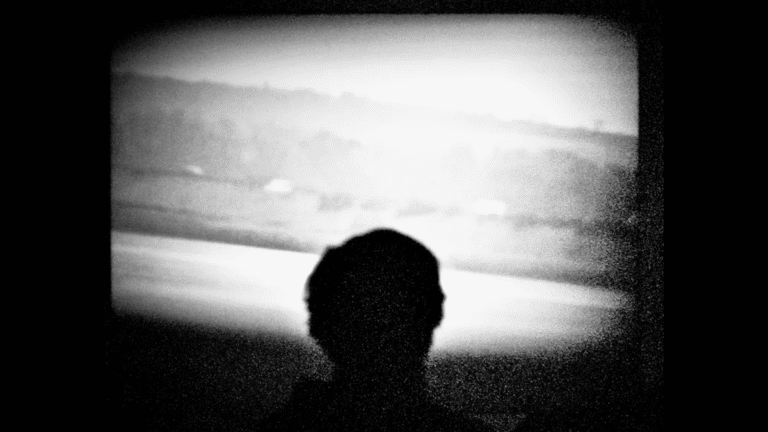
Apparition 1 / Ghosts: Deborah Stratman, O’er the Land (’09); Juan Carlos Gallardo, 90 Years Without Sleep (’13)
On Earth, the sky.
On Earth, the bird.
On Earth, the phantom menace.
On Earth, the bullet.
On Earth, the cage.
On Earth, the ball.
On Earth, the plane.
On Earth, the accident.
On Earth, the legend.
On Earth, the shots.
On Earth, the tripod.
On Earth, the camera. (In Russian, ‘camera’ is ‘prison’).
On Earth, a 16 mm film.
On Earth, Esperanza projecting.
On Earth, James Benning and Thom Andersen and Sharon Lockhart.
On Earth, CalArts.
On Earth, a tomb.
On Earth, air.
On Earth, a tomb in the air.
On earth, the sky.
Beneath the sky, the Earth.
Beneath the sky, insomnia.
Beneath the sky, the sea.
Beneath the sky, shore.
Beneath the sky, the beach.
Beneath the sky, the city.
Beneath the sky, the twilight zone.
Beneath the sky, humanity without humans.
Beneath the sky, a man.
Beneath the sky, a ghost.
Beneath the sky, a small filmmaker and his more than two hundred films.
Beneath the sky, the phantom menace: take small cameras, make small movies.
Beneath the sky, a Hi-8 camera. (In Russian, ‘camera’ is ‘prison’).
Beneath the sky, a 90 year shot.
Beneath the sky, a beep, a silence.
Beneath the sky, a private language.
Beneath the sky, time-image.
Beneath the sky, Deleuze.
Beneath the sky, Superman.
Beneath the sky, Rod Serling and Charlton Lestón and Will Smith and Jean-Luc Godard.
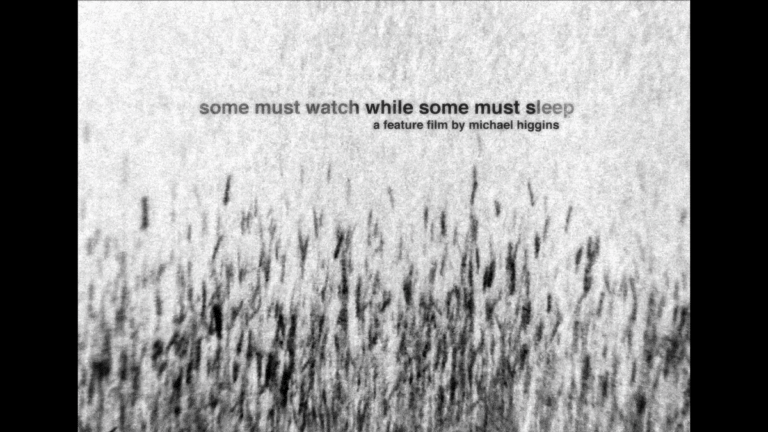
Apparition 2 / Ghosts: Experimental Film Society — Dean Kavanagh, Return of Suspicion (’14); Rouzbeh Rashidi, HSP: There Is No Escape From the Terrors of the Mind (’13); Michael Higgins, Smolt (’13), Some Must Watch While Some Must Sleep (’12)
EFS is an island.
EFS is a society.
EFS is a sect.
EFS is a secret circle.
EFS is a community without shame.
EFS, god of Saint Augustin.
Maximilian Le Cain: the centre.
Dean Kavanagh, Rouzbeh Rashidi, Michael Higgins: the periphery.
Maximilian Le Cain: P. Adams Sitney
Dean Kavanagh, Rouzbeh Rashidi, Michael Higgins: the poets.
They make confession to: Bresson, Tarkovsky, Antonioni, Lynch, Maurice Blanchot, horror.
Not to: Ken Loach, Andrea Arnold, Marcel Broodthaers, Hollis Frampton, Guy Sherwin, science fiction.
There is a politique des auteurs there.
There is a conjuring with the personal, the story of the I.
There are symbols metaphors pictures seeds tears children there.
There is white noise. Horror vacui. White terror.
There are trains ants blue roses trees there.
There is a skylight of the infinite swallowing black light.
There is a rectangle that swallows images and formats.
There is a rectangle that swallows white noise.
There is a James Blake music video.
There is an eleven-minute sequence by Bela Tarr.
There is a diffuse blue by Abel Gance, a luminous spot by Jean Epstein.
There are phantoms everywhere.
There are terrors of the mind.
There are inner landscapes.
There is an island.
There is a room.
There is a man.
There is an experiment.
There is a project.
There is a film.
There is a marvel.
There is a surprise.
The dark hours.
Mist and gloom.
White sheets.
The belles heures.
Apparition 3 / Ghosts: Arcadi Ballester, Flowers and Stripes (’14); Rubén García López, Valparaíso 2011. Observaciones de un turista (’12)
An interpreter.
We need an interpreter.
We all need an interpreter.
Soon, we all need an interpreter.
Sooner or later, we all need an interpreter.
Ourselves, sooner or later, we all need an interpreter.
To understand ourselves, sooner or later, we all need an interpreter.
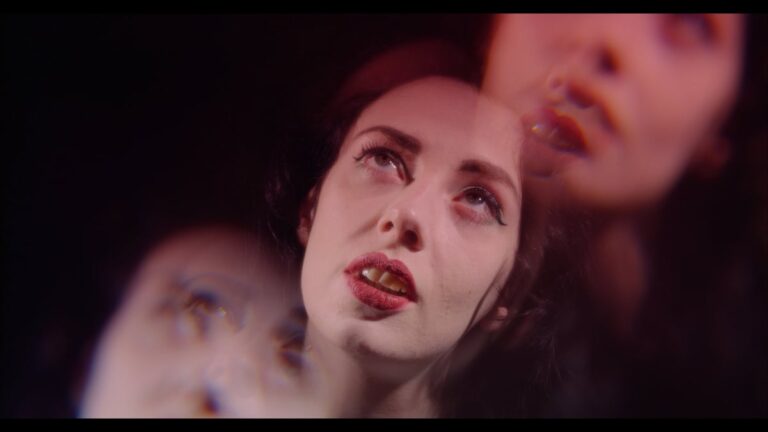
A woman.
A naked woman.
The lap of a naked woman.
Flowers in the lap of a naked woman.
An interpreter.
A naked interpreter.
The head of a nude performer.
Stripes on the head of a nude performer.
Flowers: sex, death.
Stripes: infinity, zero.
A word a phantom.
An image a phantom.
Of what we cannot talk about, we must keep our mouths shut about.
Point 7 of Pantalla Fantasma.
To Arcadi I gave a message. I gave a quote from Ovid’s Metamorphoses. I did not know what to say. Money. The other. The beautiful. Bresson’s Wound as discussed by Gonzalo García Pelayo in Three Ways to Cádiz (’14), of RGL. The flight of Phaeton. Rimbaud and Verlaine. Abyssinia.
But it is his Arcadia, the object of his most solicitous desires: The Temenos, Robert Beavers and the ghost of Markopoulos. Paint me a portrait, a tattoo, a tree. I did not know what to say. I recited her a poem.
Infernal indulgence overwhelms me
and the devil lives with my years.
If I look at my hands just claws
I see.
Night, leave your body and come to me,
with your white spirit of tattoos
filled with red crosses and stripes
of crumbling light.
How sad this world, without love
between monsters and archangels in mourning.
Juan Eduardo Cirlot
Rubén García López = RGL.
RGL makes.
RGL makes things.
RGL makes extreme things.
RGL did a thesis on JLG, is now doing one on Paulino Viota.
RGL presented pieces of Kubelkian post-porn in PF3.
RGL said extreme things about TDAS by JRT in PF3.
JRT said extreme things in PF4 about V2011ODUT.
What things?
Point 7 of Pantalla Fantasma.
V2011ODUT is a katabasis.
A katabasis is a descent into hell.
V2011ODUT is a descent into hell.
V2011ODUT, elevator, glass surface.
Pathos of distance, gnoseology of the gaze, phenomenology of perception. Perception of phenomenology, gaze at gnoseology, distance from pathos.
Surface glass elevator, V2011ODUT.
V2011ODUT, to film distance, to film the gaze, to film perception.
Cinema is an elevator, and also a crystal, a surface, cinema is a language too.
Poverty in language.
The shot does not move. The image does move.
How so?
The image does not move. The shot does move.
How so?
Cock.
50 years of Cock.
Telepizza.
20 years of Telepizza.
Gonzalo Millán, dying at nearly 60 of cancer, blue scorpion venom and telepizza, on September 2, 2006, a month before a word a gesture I shall write no more.
The city.
V.
RGL in a V.
RGL above.
RGL below.
RGL abovebelow.
V above.
V below.
V abovebelow.
Beneath the sky.
On earth.
RGL windfall.
As a divine and desiring machine.
On earth.
ODUT.
The earth trembles.
The city trembles.
The city cracks.
Panic ensues.
The ground spins.
Buildings sway.
Cables tauten.
Posts will fall.
Tiles are falling.
Believers cross themselves.
RGL ducks his head.
Ambulances wail.
Fire sirens are heard.
RGL reborn on the asphalt.
The City, Gonzalo Millán
Apparition 4 / Ghosts: Canódromo Abandonado, The Tomb of Bruce Lee (’13); Carlos Serrano Azcona, Letters from Parliament Square (’14)
There are margins and margins.
There are peripheries and peripheries.
Here is Cinema.
Da-Sein.
Margins. Org
Peripheries. Com
Cinema, tomb in the air.
Bruce Lee and Brian Haw raise their heads.
Pass away on the screen.
Modernity did not take place, Latour said.
So imagine postmodernism.
Cinema is a tomb in the air.
Peripheries. Org
Margins. Com
Da-Sein Nicht.
Cinema Is not There.
Peripheries there are and there are peripheries.
Margins there are and there are margins.
Cinema is, as well as a margin, a periphery and a tomb, an industry.
Poverty in the industry.
Apparition 5 / Ghosts: Inés García, Historia de amor en clave de sol (’14); Sean Brown, Boo Demon vs La cerveza de la muerte. Beer of death (’14)
I thought HDAECDS would resemble TDAS.
Then I thought HDAECDS was more like Lisandro Alonso and Albert Serra and Fernando Eimbcke and.
Then I thought HDAECDS would be a love story, but I didn’t have a clue.
Then I thought HDAECDS indeed was a love story, but it didn’t have the clue.
I thought it would be the fire in the image.
Then I thought it would be the bird on the rock.
I thought it would be the observation of an interior landscape without structure.
Then I thought it would be a guitar that burns slightly inside a drum filled with dry oak branches.
I thought it would play the Zamba of my hope.
Then I thought it better it didn’t.
I thought it would be better like that.
Then I thought it was better like that.
Just as well.
Just as well.
As well.
As well.
Well.
Well.
No.
No.
Not like that.
Not like that.
I thought it would be better not like that.
Then I thought it was better not like that.
I thought the Portland-porn would like RGL’s Kubelkian porn.
Then I thought it was a soap opera subtitled ‘Filth and Gentrification’.
I thought the title in English would be amusing.
Then I thought it was not only amusing but successful because of grunge and the West Coast.
I thought a metaphor was a distant and just relationship.
Then I thought a metaphor was essentially a motorcycle.
I thought Pantalla Fantasma would be the dump of cinematic excrescence, extreme and destructive.
Then I thought Pantalla Fantasma was the dump of forgotten images and Jorge Núñez, Saint George (San Jorge), Paul Klee’s Angelus, looking over the present.
I thought Alberto Ruiz Samaniego, Ovid, Derrida, Cirlot and Millán would be good companions. I had with me To Be and Not To Be. Figures in the spectral domain, Metamorphoses. Cinema and its Phantoms, From The No World. Poems (1961–1973), The City and Blue Scorpion Venom (Diaries of Life and Death).
Then I thought that this quote from Simone Weil would be a perfect way to end this text-poem phant-asy, celebrating PF4 and wishing it many more editions. As is known, spectres, such as cinema, live through repetition: “only perfect detachment lets you see things naked, free of the fog of misleading values. This is why ulcers and rubbish dumps were indispensable in revealing to Job(rge) the beauty of the world. Because there is no detachment without pain.”
by Julius Richard, January–March 2015
(1) ‘Door’ – ‘Puerta’, also the name of the venue where the festival took place.
Translated by Esperanza Collado & Maximilian Le Cain. This review originally appeared in Spanish in Transit: cine y otros desvíos.
Originally published by EFS Publications; written January–March 2015. Restored and republished as a web article in 2026; the source document is preserved in the EFS archive.