Spoor: An Installation by Natasha Bourke
By Maximilian Le Cain
Wandering around We Do Not Leave Pyramids, the 2015 Crawford College of Art and Design degree show, one encounters the usual disparity in levels of promise, maturity and accomplishment, everything from the feeble to the impressive. But every judgement is couched in and qualified by the acknowledgement that this is student work, the output of artists at or close to the start of their creative journeys. At best, one assumes, what is displayed are blocks that will be built on over decades of elaboration. It is, therefore, nothing short of astonishing to encounter Natasha Bourke’s installation Spoor in this context. This magnificent and haunting piece of work, which drew me back to the show three times, has a formal density and an emotional richness that feels so profoundly ‘lived’ that any thought of ‘promise’ or ‘student work’ is clearly inappropriate. Granted, Bourke is the better part of a decade older and more experienced than the majority of her fellow graduates. But Spoor feels like the creation of an artist with decades of work behind her, not only in terms of its formal accomplishment but in the more mysterious development of a personal poetic vision with its own iconography, its own set of tonal balances and its own thematic dream life. In fact, the title of the group show notwithstanding, there is something almost monumental about Bourke’s contribution. This quality arises naturally from its sense of absurdity traversed and a quietly defiant dignity attained in the course of the incessant temporal and spatial voyaging that Spoor chronicles. Underlying this movement is a palpable yearning, the melancholy of a search that will never find its goal, or perhaps a search that has become its own goal.
The structure and interplay of elements within this immersive installation are extremely complex but also admirably coherent and direct on an experiential level. These elements are not complex for the sake of puzzling the audience but rather to clearly and adequately present the workings of a very private world. Central to this world is Coneface, Bourke’s alter-ego performed by her wearing a semi-transparent cone over her face, made of wire and sellotape. Conical or circular shapes with various overlapping identities are the obsessively repeated motif permeating Spoor’s structure.
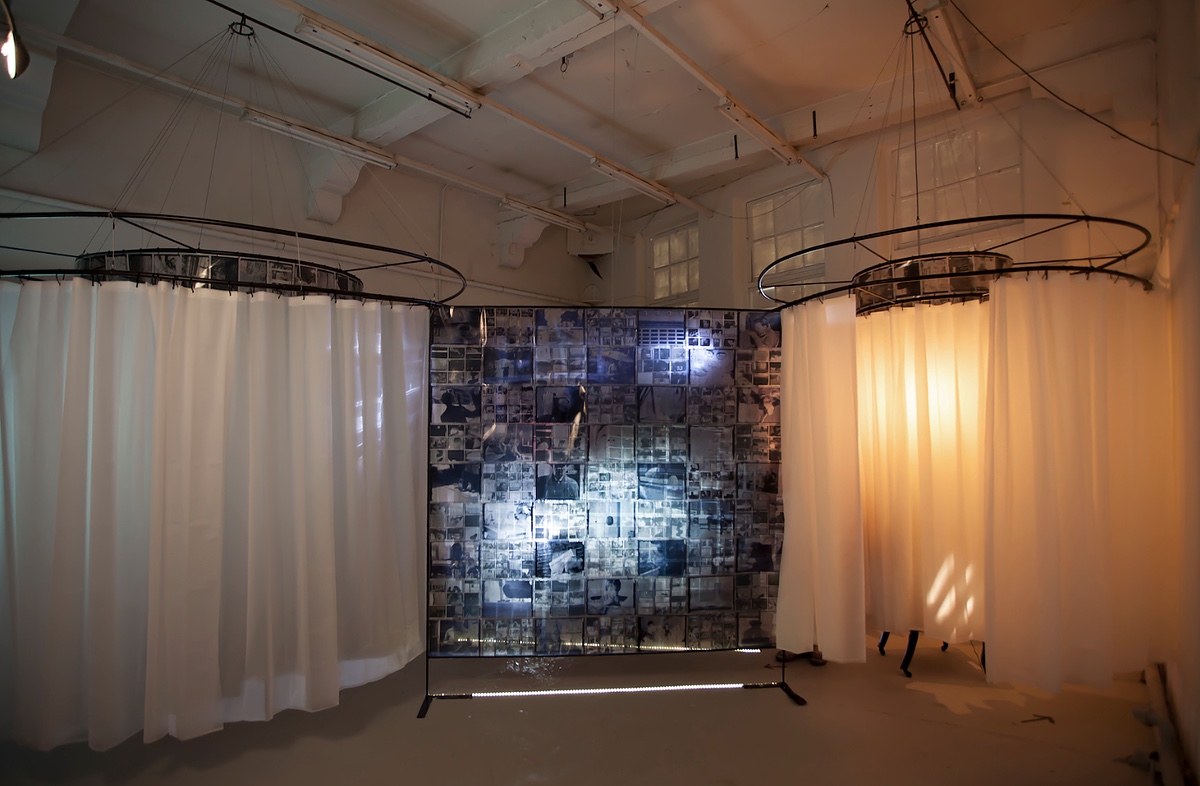
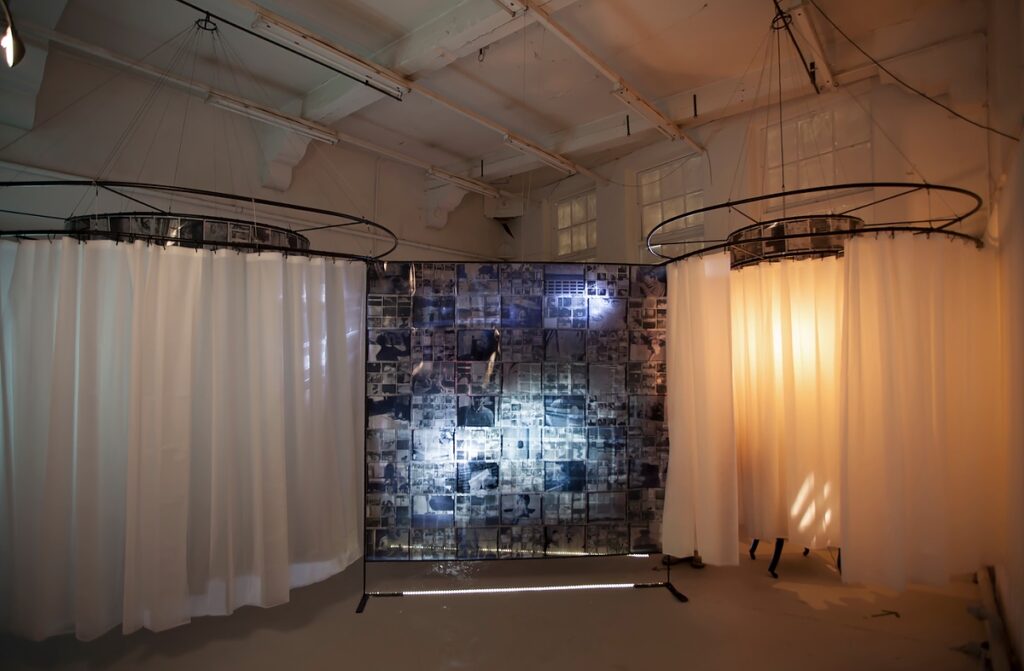
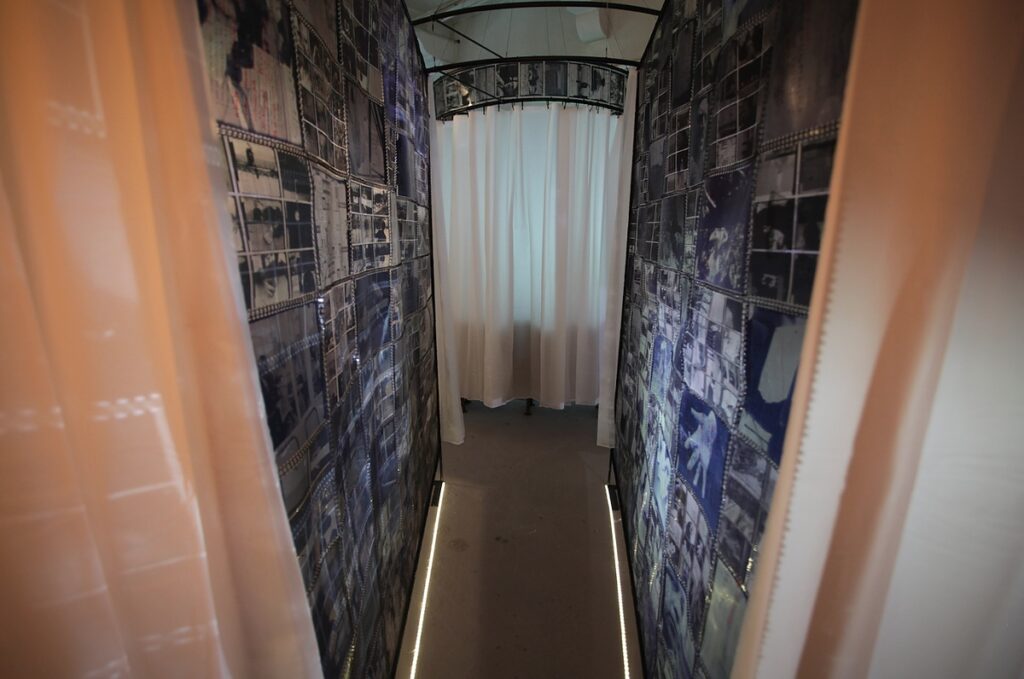
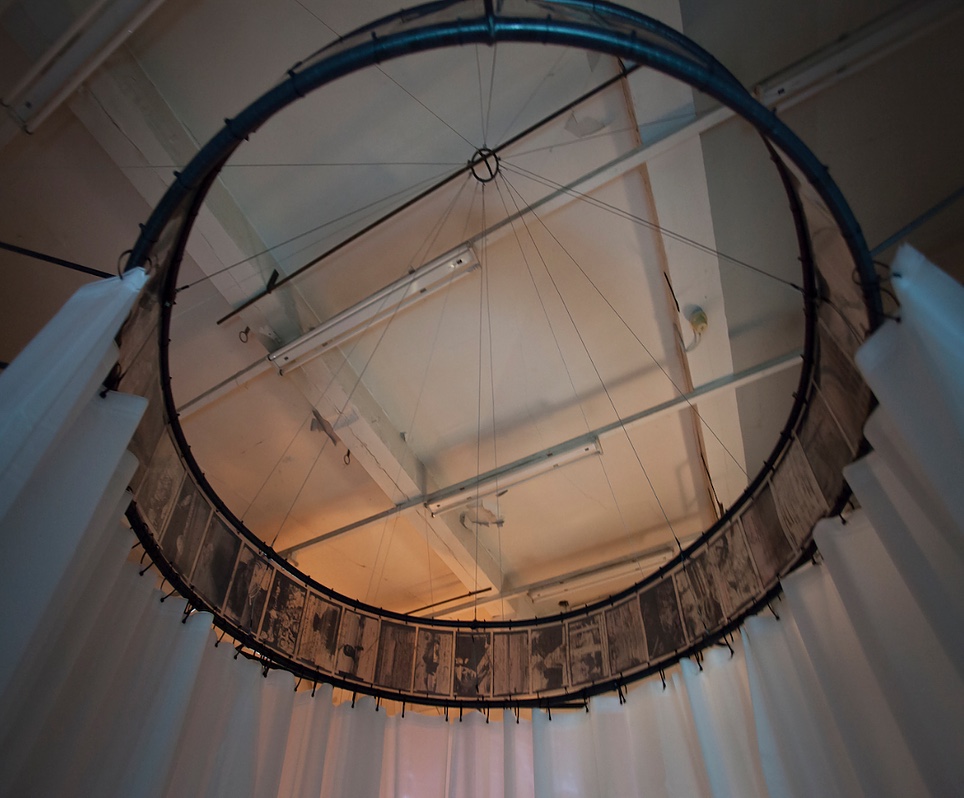
Approaching the installation, which is at the end of a very long, dim, high-ceilinged room containing several other projections, one has the feeling of moving towards a mysterious carnival show. There is a wall of soft white plastic sheeting, looking at first glance like a slightly clinical sideshow tent. Bourke herself is on hand to welcome visitors, handing them wireless headphones that amplify and make private the soundscape that is playing throughout the piece, and showing them the entrance to the rather intimidating little maze she has constructed. There are three interconnecting chambers, made from sheets of the semi-translucent plastic that turn out to be shower curtains. The two front chambers are circular, narrow passages formed of outer and inner circles of curtain between which the visitor shuffles. Passing through them feels oddly exciting as a slightly claustrophobic sense of disorientation kicks in. There are gaps in both central sections of curtain, the ‘cores’ of these circular passages. In one can be found an old fashioned chair with an antique 8mm film viewer on it. In the other is a pair of cinema seats from the 1920s. In front of them a fifteen-minute video is back projected onto the curtain, the central point of the installation. These two circular spaces are linked by a short passage the walls of which are formed of transparent acetate sheets of archival photographs with strange mathematical equations scribbled on them. This whole structure is modeled after a pair of film reels and the film running through them: the two circular chambers are reels through which we pass like film. The curtains are suspended on a double set of black circular bars unmistakeably moulded to resemble reels and the dark texture of the transparent photographs is reminiscent of a celluloid strip. Even the dainty twin rows of LED lights that run along the floor between the ‘reels’ to light our way resemble sprocket holes in this context.
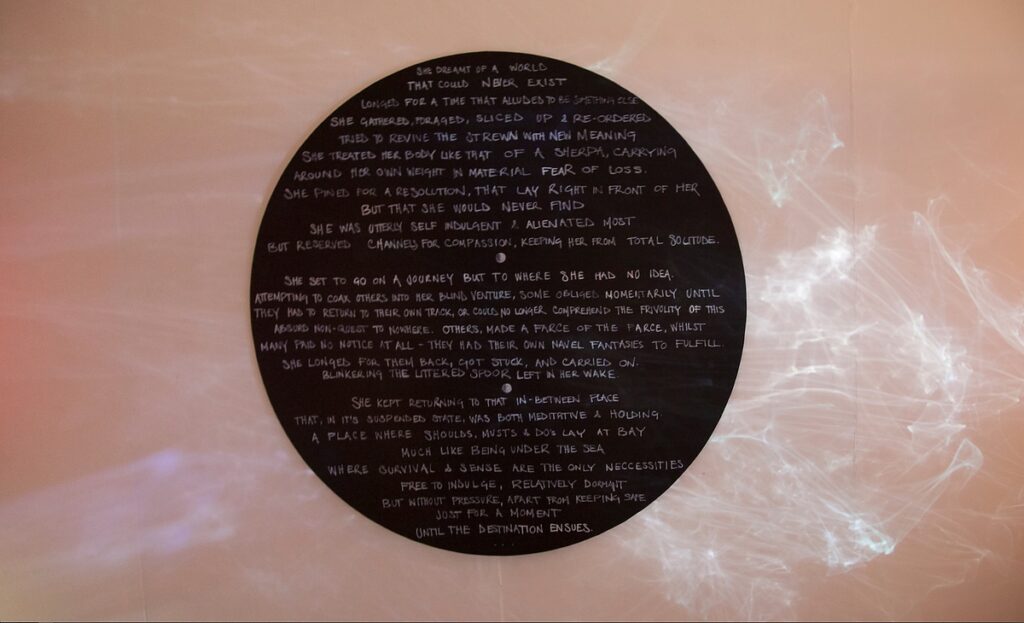
The third room, the back walls of which are actually walls rather than curtain, is dominated by a circular blackboard upon which is chalked a moving confessional statement by Coneface/Bourke. The rest of the room contains several ‘relics’, items that appear in or echo the video piece. One of these arrangements is a wedding dress that Coneface wears in the video, suspended from the wall along with the cone. Underneath it are a circular mirror and a stack of empty film reels. The apex of the cone, here pointing directly down towards the mirror, holds a tiny light bulb that sends a small cone of light down over the mirror. In previous work as well as in the video, Bourke inserted a small distorting lens instead of a light in the cone in order to see through it. It is at once a device for narrowing and reconfiguring vision and for projecting light. Almost every aspect of Spoor has an extended or reversed function in a similar way, generally in relation to seeing or to projecting and being projected upon or through. Everything is moving beyond itself, beaming out and mirroring, interrogating its identity and given capacities and, in some cases, sinking with humility into simple self-acceptance as object. Everything is linked, linked by a particular subjectivity. But this subjectivity is migrant, uprooted, looped in ongoing circles. It is articulated through a very particular tension generated between image and its technology, a tension that mirrors and extends the relationship between the self and the body (or bodies). Two statements from the circular blackboard are worth keeping in mind:
She treated her body like that of a Sherpa,
Carrying around her own weight in material fear of loss.
And:
She dreamt of a world that could never exist,
A time that alluded to be something else.
The body as an object external to oneself, threatening future loss; the dream(ing) world as already condemned to and born of loss. The former as manifest in the objects on exhibition; the latter negotiated in the video. The presence of Coneface is central to the video. But the dress she wears and her mask hang empty in the gallery, fulfilling the ‘material fear of loss’. And, yet, a small light cone is projected from the bulb in the cone mask. The light cone hints film projection but as a reversal of sight, as the end of the cone normally channels Coneface’s vision. An absent image is implied, especially when seen next to the array of analogue, mainly home movie, film equipment on display. Amongst these objects are an 8mm projector and, as mentioned before, a film viewer. The viewer is on, its bulb glowing, but with no film in it. More eloquently still, the 8mm projector lamp is lit but the strip of film in it is not running through the gate; it hangs limply in front of the lens, fluttering slightly but incapable of sending forth an image. Object and function have been divided and, with these objects, that function is creating an image: at once a dream, a memory and the ambiguous trace of a past era that invites us to project our obscure desires and assumptions into a time that probably never was. The pull of this projection (in both senses of the word) into the past is even stronger if the images in question are family movies taken before we were born.
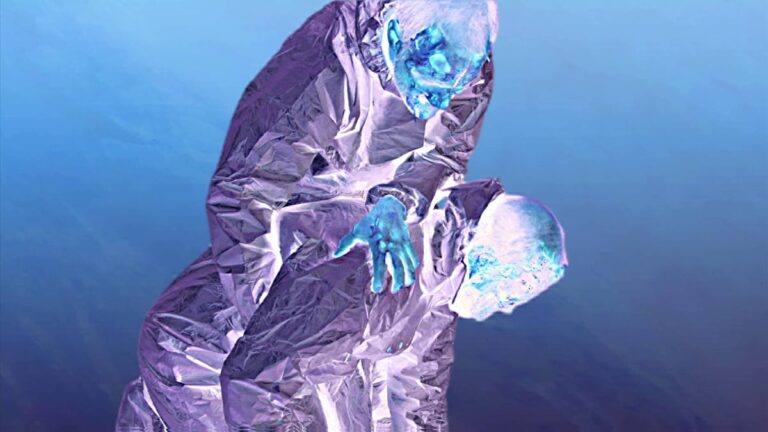
It would almost be too much to say that these images can be found in the video. Rather, they are referenced in it, invoked, present and yet not quite. Spoor’s preoccupation with analogue film equipment alludes to a very specific set of movies: family and work scenes meticulously shot on 8mm by Bourke’s grandfather, obviously a gifted and dedicated amateur filmmaker, in the ’60s. Given the aura which the whole exhibition builds around them, one might expect their appearance in the video to be iconic. Their very presence in this context, split from their physical supports, the projector and viewer that have been left pining for them, and dematerialised into the digital, is already loaded with significance. Yet they are but fleetingly included in the video, often in superimpositions or fractured multiple images included in the same frame. No story, no specific character or place, emerge from them. They convey ‘past’, ‘elsewhere’, ‘a time that alluded to be something else’. They cannot quite be located in their specificity.
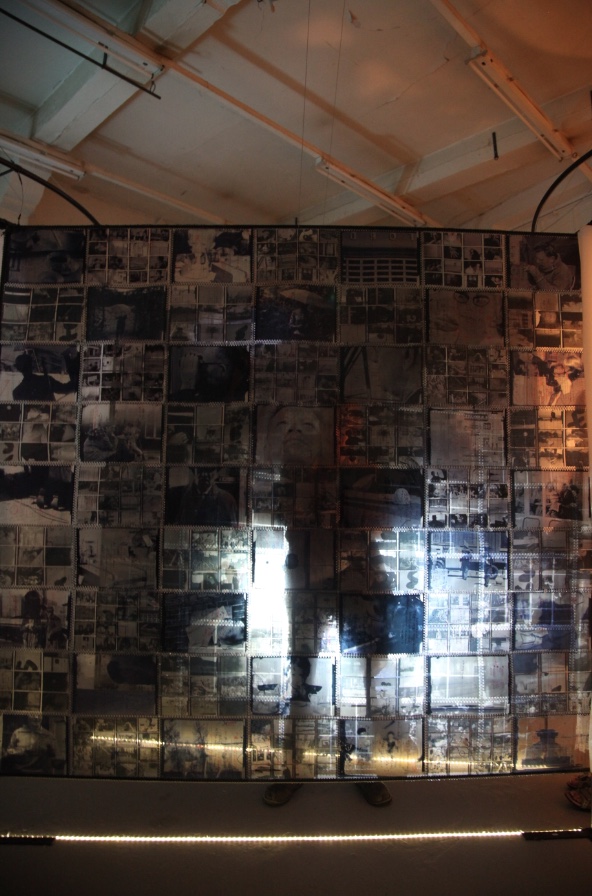
The other use of family archival material is in the semi-transparent wall of photographs that links the two circular shower-curtain rooms and it has a similar effect. Although each sheet is a uniform A4, they contain multiple images differently arranged and, as mentioned before, scrawled on with strange formulae. Try as it might, the eye is deflected from picking out any person or any situation in particular. The impression is of a texture charged with ‘past’, allusive, personal and yet hauntingly non-specific. Perhaps the specifics have already been digested. What remains can be linked to another pair of lines from the blackboard:
She pined for a resolution that lay right in front of her
but that she would never find.
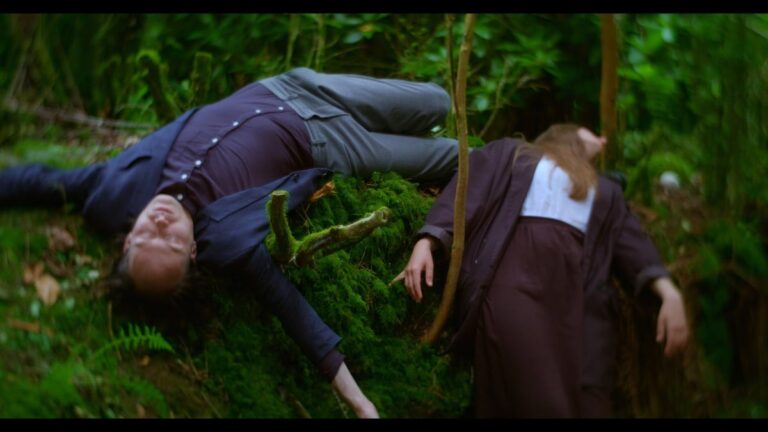
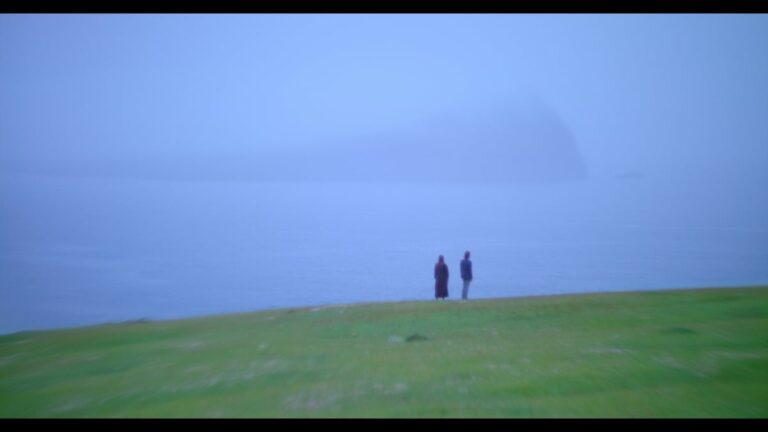
Which leads us finally to Coneface as she appears in the video. A strange, bird-like alien being, always arriving, watching, searching for something or yearning to travel elsewhere. On a throne-like seat separated from a fairy-tale castle by a lake. A boat drifts by in front of the castle; a train passes behind it. But when Coneface is in the boat, it passes through the frame, right to left, not conveying her to the castle. Coneface in a station, Coneface wandering uncertainly towards the camera up empty laneways, Coneface arriving on a mysterious shore with a little red suitcase. Enticed by layers of old 8mm movies, Coneface travels not only in space but also in time. A truly stunning superimposition places her rowing rapidly left to right across the lake over old footage from an aeroplane window as it takes off from a runway. Coneface is here and elsewhere, present and, in the empty dress and mask hanging in the exhibition, absent. But she is also not tied to a single body. There are at least two adult Conefaces in the video and in one shot she is accompanied by a child Coneface, a little girl with her cone on her head like a magician’s hat.
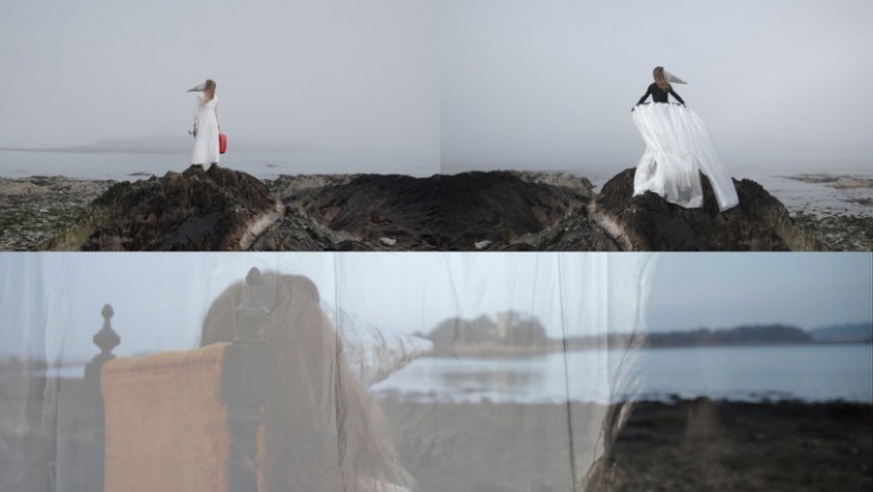
The Spoor video could easily stand on its own, apart from the installation, as a powerful and visually striking short film. In spite of embracing absurd and potentially kitsch imagery and presenting an unashamedly private inner world for public scrutiny, Bourke is able to strike a delicate balance between elements that prove vertiginously resonant. The resulting work never feels self-indulgent; the absurdism proves revealing rather than, as is so often the case, an evasion strategy. An ineffably dignified sense of melancholy prevails as the installation, even down to its ‘film reel’ floor layout, dictates that we follow Coneface in her perpetual loop, endless circles around images that were never quite there.
More on Natasha Bourke: natashabourke.com
About the author: Maximilian Le Cain is a filmmaker and film critic living in Cork City, Ireland. maximilianlecain.com
Originally published by EFS Publications, 28 June 2015. Restored and republished as a web article in 2026; the source document is preserved in the EFS archive.